Why Your Ford Brakes Are Squeaking or Grinding | Don’t Wait on This One
You’re stopped at a red light. The light turns green. You press the gas. And every head in the intersection turns toward you — because your brakes just let out a squeal loud enough to wake the dead. Your teenage passenger slides down in the seat. You pretend not to hear it. But you do. And so does everyone else.
Brake noises are embarrassing. But more than that, they’re warnings. A squeak today can become a grinding noise tomorrow — and grinding means metal-on-metal, which means expensive rotor replacement instead of cheap pads. The good news? Most brake squeaks are harmless (dust, glazing) and easy to fix. The bad news? A grinding noise means you’ve waited too long. This guide walks you through every brake noise your Ford can make, what it means, and exactly what to do — from a $10 can of brake cleaner to a $400 brake job.
TL;DR: Your Ford brakes squeak or grind because of worn brake pads (wear indicators), glazed pads (overheated), dust or debris between the pad and rotor, lack of lubrication on caliper slides, or cheap aftermarket pads. Grinding means the pads are gone — you’re hearing metal backing plate on metal rotor. This is urgent. First test: listen to when the noise happens. Squeak only when braking? That’s pads. Squeak all the time? That’s a rock or debris stuck between the pad and rotor. Grinding? Stop driving and inspect immediately. A brake job (pads and rotors) on a Ford costs $200–400 per axle for DIY, $400–700 per axle at a shop. Ignoring grinding destroys your rotors ($500+ per axle) and can lead to brake failure.
Key Takeaways
- Squeaking only when braking = normal wear indicator or glazed pads. Get pads inspected soon.
- Squeaking all the time (even without braking) = debris stuck between pad and rotor, or a backing plate rubbing. Fix now.
- Grinding or growling = pads are gone. Metal on metal. Stops driving. You’ll need pads AND rotors.
- Ford wear indicators are small metal tabs that squeak when pads are low — they’re designed to warn you.
- Cheap brake pads (economy brands) are noisier than premium ceramic pads. Spend the extra $20–30.
- A $10 can of brake cleaner and a wire brush can fix squeaky brakes (dust buildup).
- Bedding in new brakes (a series of hard stops) prevents glazing and squeaking. Many shops skip this step.
- Ford F-150 and Super Duty trucks have larger, heavier brakes that are more prone to squeaking than cars.
Ever notice your brakes squeak worse in the morning, or after it rains, or when you first drive after the car sat for a few days?
That moisture-related squeak is normal. Surface rust forms on the rotors overnight. The first few stops scrub it off, and the noise goes away. But if the noise stays, or gets worse, or turns into a grinding sound, you’ve got a real problem. Let’s figure out what your Ford’s brakes are trying to tell you.
How Your Ford’s Brakes Work (Simple Version)
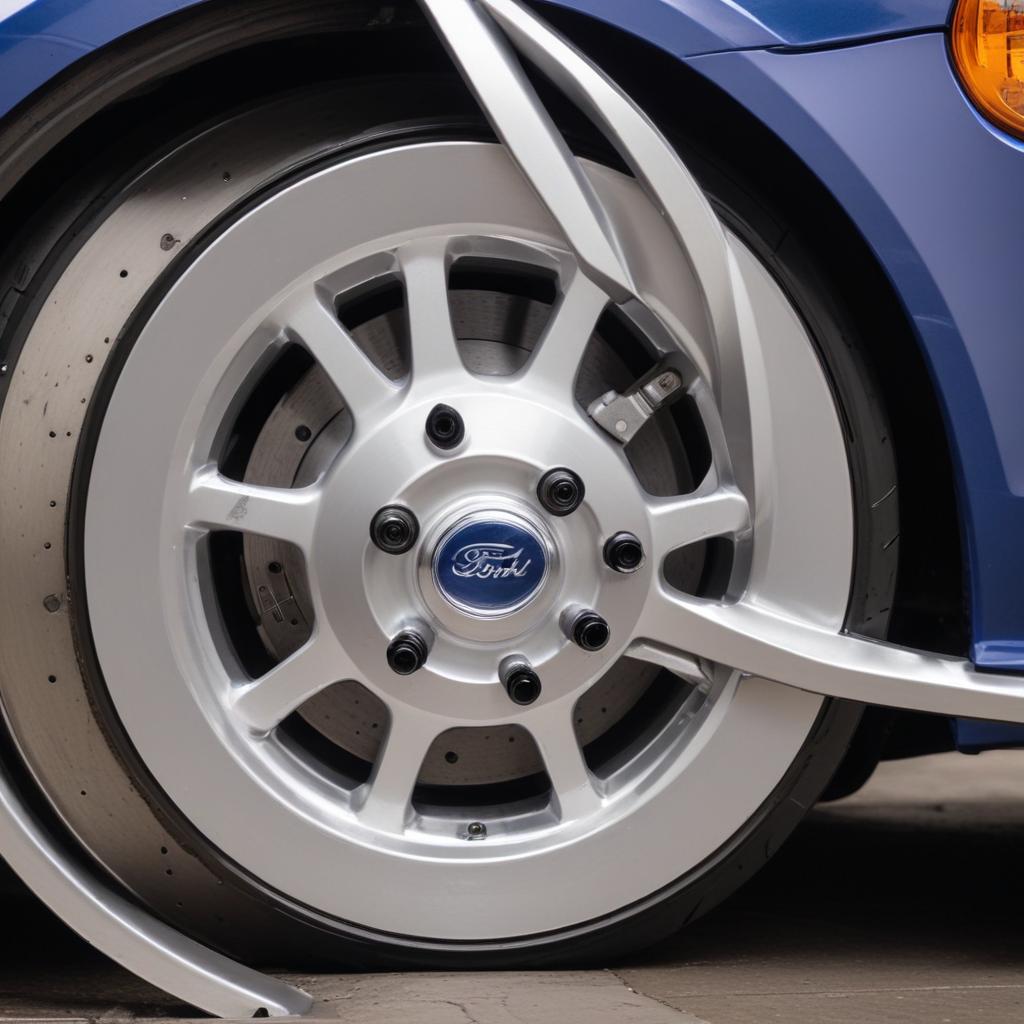
When you press the brake pedal, hydraulic fluid pushes the brake caliper to squeeze the brake pads against the brake rotor (the shiny metal disc behind your wheel). Friction slows the wheel. Over time, the friction material on the pads wears down. When it wears to about 3–4mm thick, a small metal tab called a wear indicator touches the rotor and makes a high-pitched squeak — it’s designed to warn you.
When you ignore that squeak for too long, the friction material wears completely away. Now the metal backing plate of the pad is rubbing directly on the metal rotor. That’s grinding. And that’s bad. Rotors are expensive. Pads are cheap.
“I can’t tell you how many people come in with grinding brakes and say ‘it just started making noise yesterday.’ No, it didn’t. The wear indicators were squeaking for weeks — or months. You ignored it. Now you need rotors too.” – Brake Specialist, 25 years
The 10 Reasons Your Ford Brakes Are Squeaking or Grinding
From harmless to urgent. Don’t skip the diagnosis.
1. Normal Wear Indicators (The “Change Me Soon” Squeak)
This is the most common cause of brake squeaking — and it’s intentional. Ford engineers put small metal tabs on brake pads that contact the rotor when the pad material reaches 3–4mm thick. The tab makes a high-pitched squeak every time you brake. It’s your car saying “change me soon, but not today.”
How to spot it: The squeak happens only when you press the brake pedal. It’s a high-pitched, consistent squeak. It might go away when you brake harder. The noise stops completely when you’re not braking. Your brakes still work fine — they’re just low.
What to do: Have your brake pads inspected within the next 500–1,000 miles. A shop or any brake place will do a free brake inspection. If the pads are at 3–4mm, replace them now. If they’re at 2mm, replace them immediately. Don’t wait for grinding.
The fix time: 1–2 hours at a shop, or DIY for $40–100 per axle (pads only).
Pro tip: The wear indicators are usually on the inner pad (closer to the engine). You might not see them without removing the wheel. But that squeak is unmistakable.
2. Glazed Brake Pads (The Overheating Squeak)
Brake pads can get “glazed” when they overheat — from hard braking down a long hill, towing heavy loads, or aggressive driving. The friction material hardens and becomes smooth and shiny. Glazed pads don’t grip well and tend to squeak loudly.
How to spot it: The brakes squeak when you brake, but the pads are still thick (more than 5mm). You might also notice reduced braking power — the pedal feels “hard” but the car doesn’t stop as quickly. If you recently towed a trailer or drove in the mountains, glazing is likely.
What to do: You can try to “un-glaze” the pads by sanding them. Remove the pads. Rub the friction surface with 80-grit sandpaper on a flat surface until the shine is gone. Reinstall. This works about 50% of the time. Otherwise, replace the pads. Also, consider upgrading to premium pads (ceramic or carbon-fiber) that resist glazing better than cheap organic pads.
The fix time: 1–2 hours DIY.
3. Dust, Dirt, or Debris Between Pad and Rotor (The Cheap Fix)
Brake dust (from normal wear) can build up between the pad and rotor. A small piece of grit can get embedded in the pad and cause a squeak or squeal. This is especially common after driving on dirt roads or in areas with road sand/salt.
How to spot it: The squeak might be intermittent, or change pitch when you brake harder. The pads might be thick (not worn out). The noise might come and go. Also, recently drove on gravel or dirt? That’s your culprit.
What to do: Buy a can of brake cleaner ($8–12) and a stiff brush. Remove the wheels. Spray the brake cleaner into the caliper between the pad and rotor (follow can directions — it evaporates quickly). Brush away any visible debris. Reinstall wheels. Drive. The squeak should be gone.
The fix time: 30 minutes.
Safety reminder: Brake cleaner is toxic and flammable. Work in a well-ventilated area. Don’t spray on hot brakes (drive the car, let it cool first).
4. Lack of Lubrication on Caliper Slides (The Easy DIY Fix)
Your brake caliper slides on metal pins (called slide pins or guide pins). Those pins need a thin layer of high-temperature brake grease to move smoothly. When the grease dries out, the caliper sticks. One pad wears faster, and the caliper can vibrate — causing squeaking.
How to spot it: The brake pedal might feel “grabby” — the brakes bite hard then release. The squeak might be a lower-pitched “groan” rather than a high squeal. One brake pad is wearing faster than the other on the same wheel.
What to do: Lubricate the slide pins. Remove the caliper bolts. Pull the caliper off. Slide the pins out of the rubber boots. Clean off old, dry grease with a rag. Apply a thin layer of silicone brake grease (not regular grease — it melts from heat). Reinstall. This takes 30–60 minutes per axle.
The fix time: 1–2 hours DIY for both front wheels.
Pro tip: Never use anti-seize compound on slide pins — it dries out and hardens. Use proper brake grease (Permatex, CRC, or Sil-Glyde). It’s $6–10 a tube and lasts for years.
5. Worn Brake Rotors (The “Lip” Problem)
Brake rotors wear over time. A ridge (lip) forms on the outer edge of the rotor. When the brake pads wear down enough, the edge of the pad can contact that lip and make a squeaking or scraping noise — even when the pads have plenty of material left.
How to spot it: Run your fingernail across the edge of the rotor (when cold). Do you feel a sharp lip? Also, look at the rotor surface — are there deep grooves or scoring? The brake pedal might pulse when braking (warped rotors).
What to do: Replace the rotors when you replace the pads. Front rotors cost $40–80 each. Or have the rotors “turned” (machined smooth) at a parts store ($15–25 per rotor). But on modern Ford rotors, turning (resurfacing) often makes them too thin, and they’ll warp faster. Just replace them.
The honest truth: Most shops automatically replace rotors with pads now. It’s not always necessary, but it’s the safest bet. If your rotors are smooth and not warped, you can install just pads. But if you hear grinding or groaning, replace the rotors.
6. Cheap or Low-Quality Brake Pads (The “You Get What You Pay For” Problem)
Economy brake pads ($20–30 per axle) use organic materials that generate more dust and tend to squeak more than premium pads. They also wear faster and handle heat poorly. This isn’t a failure — it’s a choice.
How to spot it: You recently installed new pads, and they’ve always squeaked. They stop fine — they’re just noisy. You bought the cheapest pads at the parts store.
What to do: Replace the pads with premium ceramic pads ($50–80 per axle). Ceramic pads produce less dust, are quieter, and last longer. They also work better when cold. On Ford trucks and SUVs, ceramic pads are worth the extra money.
Pro tip: Motorcraft (Ford OEM) pads are ceramic and good quality. But aftermarket brands like Akebono, Bosch, PowerStop, and Wagner are excellent — often better than OEM for less money.
7. Debris Stuck Between Backing Plate and Rotor (The Annoying Scrape)
Your Ford has a thin metal backing plate (dust shield) behind each brake rotor. A small rock, pebble, or piece of road debris can get wedged between the shield and the rotor. It makes a horrible scraping or squealing noise — and it can happen even when you’re not braking.
How to spot it: The noise happens all the time — not just when you brake. It might sound like metal scraping or squealing that changes with wheel speed (faster as you accelerate, slower as you stop). It might come and go as the rock shifts.
What to do: Drive slowly in reverse (5–10 MPH) and brake gently. This often dislodges the rock. If that doesn’t work, remove the wheel and use a long flathead screwdriver to push the dust shield away from the rotor slightly (just a few millimeters). The rock will fall out. Bend the shield back by hand.
The fix time: 20 minutes.
8. Seized Caliper (The Urgent One)
A brake caliper can seize (get stuck) in the applied position. That means the brake pad is constantly touching the rotor — even when you’re not braking. You’ll hear a grinding or scraping noise all the time, and your Ford will pull to one side.
How to spot it: The noise happens constantly, not just when braking. One wheel is significantly hotter than the others after driving (touch the center of the wheel, not the rotor). Your Ford feels sluggish. You might smell burning brakes. Fuel economy drops.
What to do: Replace the seized caliper immediately. Do not drive. A seized caliper can get hot enough to boil brake fluid, catch fire, or lock up the wheel at highway speed. Part cost $60–120. A shop will charge $300–500 to replace the caliper, bleed the brakes, and replace pads (pads on that wheel will be destroyed).
Safety reminder: If you see smoke or smell a strong burning smell from a wheel, pull over and call a tow truck. This is a fire risk.
9. Warped Brake Rotors (The Pulsing Problem)
Warped rotors don’t typically squeak — they cause a pulsing sensation in the brake pedal. But severely warped rotors can cause uneven pad contact, which can lead to squeaking or groaning. Warping usually comes from overheating (hard braking, towing) or from holding the brake pedal after a hard stop (pad deposits transfer to the rotor).
How to spot it: When you brake, the brake pedal pulses (vibrates) under your foot. The steering wheel might shake when braking from highway speed (warped front rotors). The noise might be a “wa-wa-wa” sound that matches wheel speed.
What to do: Replace the rotors. Resurfacing (turning) warped rotors is possible, but on modern Ford rotors, they’ll warp again quickly. New rotors cost $40–80 each. Replace pads at the same time.
The fix time: 1–2 hours per axle.
10. Backing Plate Rubbing on Rotor (The Bent Metal Noise)
The dust shield (backing plate) is a thin piece of metal. If it gets bent (from a pothole, curb, or previous brake work), it can rub against the rotor. The noise is a constant scraping or metal-on-metal sound — similar to a stuck rock, but it doesn’t go away.
How to spot it: Noise is constant, happens with or without braking. The car drives and brakes normally. Look behind the wheel — can you see the dust shield touching the rotor? Push on it with a long screwdriver — if the noise changes or stops, you found it.
What to do: Use a long flathead screwdriver to gently push the dust shield away from the rotor (away from the car). Bend it just a few millimeters. The noise should stop.
The fix time: 10 minutes per wheel.
Comparison: Brake Noises and What They Mean
| Noise | When It Happens | Likely Cause | Urgency |
|---|---|---|---|
| High-pitched squeak | Only when braking | Wear indicator (pads low) | Medium — inspect soon |
| High-pitched squeak | Only when braking, pads thick | Dust, glazing, cheap pads | Low — fix when convenient |
| Squeal or chirp | First few stops after rain/morning | Surface rust on rotors | None — normal |
| Grinding or growling | Only when braking | Pads are gone, metal on metal | HIGH — stop driving |
| Grinding or scraping | All the time, even when not braking | Rock stuck, seized caliper, bent shield | HIGH (seized caliper) |
| Groaning or low-pitched squeak | Only when braking, especially at low speed | Lack of lube on slide pins | Low — fix soon |
| Thumping or “wa-wa-wa” | Only when braking, pedal pulses | Warped rotors | Medium — replace rotors |
| Squealing that changes with speed | Constant, matches wheel speed | Bent dust shield or debris | Low — easy fix |
Real Story: How I Ignored a Squeak and Paid $400 for a Rotor
I had a 2016 Ford Fusion. The brakes started squeaking. I knew it was the wear indicators. I knew I needed pads. But I was busy. I said “I’ll do it next weekend.”
Next weekend came and went. Then the next. The squeak got louder. Then one day, on the highway, I pressed the brakes and heard a horrible grinding noise. The brake pedal felt weird. I pulled over.
The front passenger brake pad had worn completely through. The metal backing plate was grinding into the rotor. The rotor was destroyed — deep grooves, ruined. I needed new pads AND new rotors. And of course, you do both sides, so I needed two rotors and two sets of pads instead of just pads.
What would have been a $60 brake pad job (DIY) turned into a $200 brake pad + rotor job (DIY). If I took it to a shop, it would have been $200 vs $500. I learned my lesson: don’t ignore the squeak.
“Wear indicators are designed to give you 500–1000 miles of warning. That’s about a month of normal driving. If you hear that squeak, you have a month to get your brakes done. If you ignore it, you’ll be back for rotors too.” – Brake Engineer, Ford Supplier
How to Inspect Your Ford Brake Pads Without Removing Wheels (Quick Check)
You don’t always need to remove the wheel to check pad thickness.
Method 1 — Through the wheel spokes: Look between the spokes of your wheel. You can see the brake caliper. Look at the edge of the brake pad where it contacts the rotor. If the friction material is thinner than a pencil eraser (about 3–4mm), replace them. If it’s down to metal, replace immediately.
Method 2 — End of the pad: Some Ford pads have a slot in the middle. If the slot is still deep, pads are fine. If the slot is almost gone, pads are low.
Method 3 — The finger test (requires wheel removed): Remove the wheel. Run your finger along the rotor surface (when cold). Should be smooth, not grooved. Check the pad thickness. New pads are 10–12mm. Replace at 3–4mm.
Safety reminder: Never touch brake rotors or calipers right after driving. They are extremely hot — enough to cause serious burns. Always let the car cool for at least 30 minutes before inspecting.
How to “Bed In” New Brake Pads (Prevent Squeaking)
Most squeaks on brand new brakes happen because the pads weren’t “bedded in” correctly. Bedding in transfers a thin layer of pad material to the rotor and matures the pad compound.
The proper bedding procedure (on an empty road, no traffic):
- Find a safe, straight, empty road.
- Accelerate to 40–50 MPH.
- Brake firmly (not hard enough to lock up) down to 5–10 MPH.
- Do this 5–6 times in a row.
- Drive normally for 10–15 minutes without using the brakes hard (to cool them).
- Do not hold the brake pedal after a hard stop — it transfers uneven pad material and causes warping.
What not to do: Drive normally for the first 200 miles. Avoid hard braking. If your new brakes squeak right after installation, they probably need to bed in. Go do the procedure.
Chart: Brake Pad Wear vs. Time (Miles to Replacement)
This chart shows approximate pad life for different driving conditions.
🛑 Ford Brake Pad Life Expectancy by Driving Style (Front Pads)
Source: Brake manufacturer data + fleet vehicle tracking. Estimates based on Ford F-150 and Explorer.
How to Extend Brake Pad Life (And Prevent Squeaking)
- Anticipate stops. Coast to red lights instead of braking at the last second. Saves pads AND gas.
- Downshift on long hills. Use engine braking (tow/haul mode or manual gear selection) to save your brakes.
- Don’t ride the brake pedal. Resting your foot on the brake causes glazing and uneven wear.
- Bed in new pads properly. See above procedure.
- Use ceramic pads. They last longer, produce less dust, and are quieter than organic or semi-metallic.
- Replace rotors every other pad change. Two sets of pads to one set of rotors is a good rule.
FAQ: Real Questions from Ford Owners
1. Is it safe to drive with squeaking brakes?
Usually yes — if it’s a squeak (not a grind). Squeaking often means wear indicators (low pads), glazing, or dust. You have time (weeks to a month). But if it’s grinding (metal on metal), stop driving. You’re destroying expensive rotors and risking brake failure.
2. Why do my brakes squeak only in reverse?
It’s common for brake pads to develop a slight leading edge wear pattern. When you brake in reverse, the pad contacts the rotor at a slightly different angle, causing vibration and noise. Not dangerous, but annoying. Usually goes away with new pads.
3. Can rain or humidity cause brake squeaking?
Yes — surface rust forms on rotors overnight. The first few stops scrub it off, and the noise goes away. This is normal. If the noise persists all day after driving, it’s not just moisture.
4. How much does a brake job cost on a Ford F-150?
DIY pads only: $40–80. DIY pads and rotors: $150–250. Shop pads only: $200–350 per axle. Shop pads and rotors: $400–700 per axle. Rear brakes are usually cheaper because they do less work.
5. Do I need to replace all four brakes at once?
No. Front brakes do 60–70% of the stopping work. Front pads wear about twice as fast as rear pads. You can replace front pads twice for every one rear pad replacement. But always replace both sides of an axle (both front wheels together).
6. Why do my new brakes squeak?
Either they weren’t bedded in properly (do the bedding procedure), you have cheap pads (organic or low-quality semi-metallic), or the slide pins weren’t lubricated. If the squeak persists after 500 miles, replace with ceramic pads.
7. Can I just replace pads without resurfacing rotors?
Yes, if the rotors are smooth (no grooves), not warped (no pedal pulse), and above minimum thickness. But many shops insist on doing rotors for liability. If you DIY, inspect your rotors carefully. If they have a shiny glaze, sand them with 80-grit sandpaper in a circular motion.
8. How long can I drive with squeaking brakes (wear indicators)?
About 500–1,000 miles. That’s roughly a month of normal driving. Use that time to schedule a brake job. Don’t push it to 2,000 miles — you’ll hit metal backing plate.
9. Why does my Ford brake pedal feel spongy after a brake job?
Air in the brake lines — the system wasn’t bled properly. Take it back to the shop. If you DIY, you need to bleed the brakes (remove air bubbles). Watch a YouTube video — it’s easy but requires two people or a pressure bleeder.
10. Can a stuck caliper cause just one brake pad to wear out faster?
Yes — a caliper that’s stuck and not releasing will drag that pad against the rotor, wearing it down in weeks. If one pad is significantly thinner than the other pad on the same wheel, the caliper slide pins are stuck or the caliper piston is seized. Lubricate the pins first. If that doesn’t fix it, replace the caliper.
References:
- Ford Official Support – Brake Noise Diagnostics
- Consumer Reports – Why Your Brakes Are Squeaking and How to Fix Them
- F-150 Forum – Brake Pad & Rotor Recommendations (Real Owner Reviews)
- NHTSA – Brake Safety: Maintenance and Warning Signs
Is your Ford making a brake noise that’s embarrassing — or scary? Drop your year, model, and a description of the noise (squeak? grind? groan? only when braking? constantly?) in the comments. We’ve diagnosed thousands of brake problems and can tell you whether it’s a $10 can of cleaner or a $400 brake job.