Ford AC Not Blowing Cold Air? Quick Fix Guide for Hot Summer Days
It’s 95 degrees outside. You’re stuck in traffic. Sweat is dripping down your back. And your Ford’s AC is just pushing around hot, moist air like a hairdryer aimed at your face.
Few things ruin a drive faster than a broken air conditioner. But before you panic and take it to a dealer for a $1,500 repair, here’s some good news: most Ford AC problems are cheap and easy to fix. Like, $20 and ten minutes easy. This guide walks you through every possible cause — from a $10 can of refrigerant to a $50 blower motor resistor — and tells you exactly what to check first.
TL;DR: Your Ford AC blows warm because of low refrigerant (leak), a bad AC compressor, a blown fuse, a faulty blend door actuator, or a clogged cabin air filter. First check: is the compressor spinning? Look under the hood while someone turns the AC on. No click or spinning? Check the AC fuse ($5 fix). Low refrigerant? Try a recharge kit with gauge ($40–60). Still not cold? The blend door actuator is the #1 hidden failure on 2010–2020 Fords. It’s a $50 part that takes 30 minutes to replace.
Key Takeaways
- Check the easy stuff first: Fuses, cabin air filter, and AC relay. Most fixes cost under $20.
- The AC compressor clutch should click and spin when you turn on AC. If not, either low refrigerant or electrical problem.
- Blend door actuator failure is super common on F-150s, Explorers, and Edges. One side blows cold, the other hot.
- Low refrigerant means you have a leak. Recharge kits work temporarily, but the leak will come back.
- Never buy the cheapest AC recharge can — get one with a gauge so you don’t overfill and blow seals.
- If you hear clicking behind the dashboard, that’s a bad blend door actuator. Replace it before it strips the gears completely.
Ever notice one side of your Ford blows ice cold but the passenger side feels like a desert?
That’s not a design flaw. That’s your blend door actuator saying goodbye. Fords have separate temperature controls for driver and passenger on many models. Each side has its own little motor that moves a door to mix hot and cold air. When one motor fails, that side gets stuck on full heat or full cold. Let’s figure out which part is lying to you.
The Simple Job of Your Ford’s AC System (No AC Degree Required)
Think of your AC system like a refrigerator for your dashboard. The compressor squeezes refrigerant gas into a hot, high-pressure state. The condenser (looks like a small radiator in front of your engine radiator) cools that gas into a liquid. The expansion valve or orifice tube sprays that liquid into the evaporator (inside your dashboard). As the liquid turns back to gas, it gets very cold — like how rubbing alcohol feels cold on your skin. A fan blows air across that cold evaporator, and voila: cold air in your face.
When any part of this chain breaks, you get warm air.
“I tell my customers that 70% of ‘no AC’ complaints on Fords are either low refrigerant or a failed blend door actuator. Both are do-it-yourself fixes if you’re willing to watch a 10-minute YouTube video.” – Ford HVAC Specialist, 15 years
The 8 Real Reasons Your Ford AC Blows Warm Air
From most common to least. Try these in order.
1. Low Refrigerant (The #1 Cause — Means You Have a Leak)
Your AC system is sealed from the factory. Refrigerant doesn’t get “used up” like gas. If it’s low, there’s a leak somewhere. Could be a pinhole in a hose, a leaking condenser (rock damage), or a bad seal at the compressor.
How to spot it: Under the hood, locate the AC lines (aluminum pipes with black rubber hoses). Look for oily residue — refrigerant leaks leave oil behind. Also, listen for a hissing sound when the AC is running.
What to do: Buy an AC recharge kit with a gauge ($40–60 at Walmart, AutoZone, or Amazon). Follow the instructions exactly. Do NOT just buy the cheapest can without a gauge. Overfilling can blow the compressor seals, turning a $50 fix into a $1,200 repair.
Important: If your Ford is older than 2010, it uses R134a refrigerant (green cans). 2015+ Fords use R1234yf (expensive — $150+ per pound). Check your under-hood sticker before buying anything.
Safety reminder: Never puncture an AC line or vent refrigerant to the atmosphere. It’s illegal in most states and bad for the environment. Take old cans to auto parts stores for recycling.
2. Blown AC Fuse or Relay (The 50-Cent Fix)
The AC compressor needs electricity to engage. If a fuse pops or a relay fails, the compressor never gets the signal. This is the first thing you should check — it’s free and takes 30 seconds.
How to spot it: Turn on the AC. Pop the hood. Look at the front of the AC compressor pulley (passenger side, lower front of engine on most Fords). The center part of the pulley (the clutch) should spin when AC is on. If it’s not spinning, check fuses.
What to do: Open your under-hood fuse box (black plastic box near battery). Look on the fuse box lid for a diagram. Find the fuse labeled “AC” or “A/C Clutch” or “Compressor.” Pull it out. Look at the metal strip inside. If it’s broken, replace it with the same amperage (usually 10 or 15 amps). Also swap the AC relay with an identical relay (like the horn relay). If the AC starts working, buy a new relay ($10–15).
Pro tip: Keep a $10 assortment of fuses in your glove box. They fail randomly, and being stuck without AC because of a 50-cent fuse feels silly.
3. Bad Blend Door Actuator (The “One Side Cold, One Side Hot” Problem)
This is the sneaky one. Your AC system is working perfectly — cold refrigerant is flowing, compressor is spinning, everything is fine. But the blend door actuator (a small electric motor behind your dashboard) that directs air over the cold evaporator is broken. So your AC blows warm even though the system is ice cold.
How to spot it: Turn the temperature dial from cold to hot. Do you hear a clicking, ticking, or grinding noise behind the dashboard? That’s stripped plastic gears inside the actuator. Also, does one side of the car blow cold and the other warm? That’s a failed actuator for that side.
Most common Ford models with this problem:
- F-150 (2011–2020) — driver side or passenger side actuators fail
- Explorer (2011–2019) — rear AC actuator also fails often
- Edge (2015–2024) — the blend door is mounted on the side of the center console
- Escape (2013–2020) — under the driver side dash, tight to reach
What to do: Replace the actuator. Part costs $30–60 on Amazon or RockAuto. Labor is 30 minutes to 2 hours depending on the model. Watch a YouTube video for your exact Ford year and model. On F-150s, the driver side actuator requires removing the lower dash panel (4 screws). On Explorers, you sometimes have to drop the glove box.
Real talk: Some Ford actuators are buried deep. If you’re not comfortable contorting upside down under the steering wheel, pay a shop $200–350. Still better than a new car.
4. Clogged Cabin Air Filter (The “I Never Knew My Car Had One” Problem)
Every Ford built after 2005 has a cabin air filter. It cleans the air coming into your interior. When it gets clogged with leaves, dust, and mouse nests, airflow drops dramatically. Your AC works fine, but barely any cold air comes out of the vents.
How to spot it: Turn the fan to maximum. Can you hear the blower motor screaming but feel almost no air at the vents? That’s a clogged filter. Also, does your car smell musty or like dirty socks when AC first turns on? Clogged filter.
What to do: Replace the cabin air filter ($12–25). On most Fords, it’s behind the glove box. Open the glove box, squeeze the sides to drop it down, and you’ll see a rectangular cover. Pull it off, slide the old filter out, slide the new one in. 5 minutes.
Where it’s located on popular Fords:
- F-150 (2015+): Behind glove box
- Mustang (2015+): Passenger footwell, behind a plastic cover
- Explorer: Behind glove box
- Escape: Behind glove box
- Focus/Fiesta: Behind glove box
Safety reminder: Change your cabin air filter every 12–15,000 miles or once a year. A clogged filter also strains your blower motor, which can burn it out ($300+ repair).
5. Failed AC Compressor (The Expensive One)
The compressor is the heart of your AC system. When it fails, nothing works. Either the clutch won’t engage, the internal piston seals blow, or the bearings seize.
How to spot it: Turn on the AC and look under the hood. Does the compressor pulley spin freely but the center clutch never clicks and locks? Bad clutch or low refrigerant. Does the compressor make a loud grinding or rattling noise? Bad internal bearings. Does the engine belt squeal when AC turns on? Compressor is seizing.
What to do: A compressor replacement is not a DIY job for most people. Requires evacuating refrigerant, replacing the compressor, pulling a vacuum, and recharging. Shop cost: $800–1,500 depending on model. On Ford F-150s, expect $1,000–1,300. On Mustangs, $900–1,200.
Cost to ignore it: A seized compressor can snap your serpentine belt, leaving you stranded with no power steering, no alternator, and no water pump. That’s a tow truck plus a belt plus a compressor.
6. Failed Blower Motor or Resistor (The “No Air At All” Problem)
If your AC blows warm but also blows nothing — no air from vents at any speed — that’s not an AC problem. That’s a blower motor or blower motor resistor failure.
How to spot it: Turn the fan speed dial. Does the fan work on High but not on Low or Medium? That’s a failed blower motor resistor ($20–40 part). Does the fan not work at any speed? Could be a blown fuse or dead blower motor ($50–80 part).
What to do for resistor: On most Fords, the blower motor resistor is located near the blower motor (passenger side, under the glove box behind the lower trim panel). It’s a small plastic part with a electrical plug. Replace it. 20 minutes.
What to do for blower motor: If the resistor and fuses are fine but no air moves, replace the blower motor. Part costs $50–100. Labor 1 hour (tight squeeze on some models).
7. Leaking or Clogged AC Condenser
The condenser sits in front of your radiator. It looks like a small radiator. Rocks, road salt, and bugs can punch holes in it or clog the fins. When the condenser can’t cool the hot refrigerant, your AC blows warm — especially at idle or in traffic.
How to spot it: Look through the front grille. Is the condenser dented, covered in bug guts, or showing green or oily residue? Use a flashlight. Also, does your AC get cold when driving on the highway but warm at stoplights? Airflow through the condenser helps. If it only works on the highway, suspect a condenser or cooling fan problem.
What to do: A clogged condenser can be cleaned with a garden hose (spray from the back forward). A leaking condenser needs replacement ($150–300 part, 2–3 hours labor). On F-150s, the front grille and radiator support have to come off — not a beginner DIY.
8. Bad AC Pressure Switch
The pressure switch tells the compressor when the refrigerant pressure is high enough to engage. If this switch fails, the compressor never turns on — even if the system is fully charged.
How to spot it: You’ve checked the fuses, the relay is good, and the refrigerant pressure gauge shows normal. But the compressor clutch never clicks. Jump the pressure switch connector with a paper clip (look up the procedure for your Ford first). If the compressor engages, replace the pressure switch ($20–30).
What to do: Locate the pressure switch on the AC line near the passenger side firewall or near the condenser. It screws on with a Schrader valve (like a tire valve). Replace it without losing refrigerant if you’re quick. Or take it to a shop ($100–150 total).
Comparison: Ford AC Problems by Model and Year
| Ford Model | Most Common AC Failure | DIY Difficulty | Part Cost | Shop Cost |
|---|---|---|---|---|
| F-150 (2015–2024) | Blend door actuator (driver side) | Medium (tight space) | $35–55 | $300–450 |
| F-150 (2009–2014) | Low refrigerant (leaky evaporator) | Hard (dash removal) | $200+ | $1,500–2,500 |
| Explorer (2011–2019) | Rear AC actuator failure | Easy (rear trim panel) | $25–40 | $200–300 |
| Mustang (2015–2024) | AC compressor clutch failure | Medium | $150–250 | $800–1,100 |
| Escape (2013–2020) | Blend door actuator clicking | Hard (under radio) | $30–50 | $350–500 |
| Edge (2015–2024) | Blower motor resistor | Easy | $20–30 | $150–200 |
| Focus (2012–2018) | Evaporator core leak | Very Hard (dash out) | $100–150 | $1,800–2,500 |
Note on Focus and F-150 evaporator cores: If your Ford needs an evaporator core replacement, the entire dashboard has to come out. That’s 8–10 hours of labor. On a $3,000 car, it’s usually not worth fixing. Trade it in.
Real Story: How I Fixed My F-150’s AC for $47 (Dealer wanted $980)
I almost traded in my 2016 F-150 last summer. The AC blew warm on the driver side but cold on the passenger side. The dealer said both blend door actuators were bad and wanted $980 parts and labor. Then they said “while we’re in there” they recommended a $400 cabin air filter and AC recharge.
I went home angry. Watched three YouTube videos. Bought two Motorcraft blend door actuators on Amazon for $47 total. Spent a Saturday afternoon with a screwdriver and a headlamp. The driver side actuator took 45 minutes (you have to lay upside down and use a stubby screwdriver). The passenger side took 20 minutes.
Cleared the codes, started the truck, and ice cold air on both sides. That was 18 months ago. Still working perfectly.
“The markup on blend door actuator replacement is insane. Dealers charge 5–8 hours of labor. A good DIYer can do it in 2 hours max. The part is $30. Do the math.” – Independent Ford Mechanic
Chart: Most Common Ford AC Failures by Age of Vehicle
This chart shows what typically fails as your Ford gets older. Notice how blend door actuators fail early (3–6 years), while compressors and evaporators fail later.
❄️ Most Common Ford AC Failure by Vehicle Age (Owner Reports)
Source: Survey of 5,000+ Ford owners (2023–2025). Percentages per age group.
Quick Diagnostic Flowchart for Your Ford AC (No Tools Version)
Question 1: Does any air come out of the vents?
- No air at any speed → Blown fuse, dead blower motor, or bad resistor (start with fuses)
- Yes, but it’s warm → Go to Question 2
Question 2: Does the air get colder when you drive on the highway?
- Yes, much colder → Condenser airflow problem (check for debris, or cooling fan not running)
- No, always warm → Go to Question 3
Question 3: Is one side cold and the other side warm?
- Yes → Blend door actuator failure (replace actuator for that side)
- No, all vents warm → Go to Question 4
Question 4: Do you hear a click from under the hood when someone turns on the AC?
- No click → Low refrigerant or electrical problem (check fuses, then recharge)
- Yes click, but still warm → Compressor internal failure or clogged expansion valve (shop time)
Safety reminder: If your Ford AC suddenly stops blowing cold and you see smoke from under the hood, turn off the AC immediately and pull over. The compressor may have seized and is burning the belt. This can catch fire in rare cases.
How to Recharge Your Ford’s AC the Right Way (Step-by-Step)
If you’ve confirmed the compressor isn’t engaging and the fuses are good, low refrigerant is likely. Here’s how to do it safely.
What you need: Recharge kit with a gauge ($40–60), safety glasses, gloves.
Step 1: Start your Ford and turn the AC to maximum cold, fan on high.
Step 2: Locate the low-pressure port. On all Fords, it’s on the larger aluminum AC line (the small line is high pressure — do not touch that one). It has a black or blue plastic cap labeled “L” or “Low.” Usually near the passenger side firewall or near the condenser.
Step 3: Attach the recharge kit hose to the port. It only fits on the low side — won’t click onto the high side (safety feature).
Step 4: Read the gauge. If the needle is in the green zone (25–45 PSI), you’re not low. Stop. If it’s in the white or red zone (under 20 PSI), proceed.
Step 5: Squeeze the trigger on the can for 5–10 seconds. Shake the can every few seconds. Watch the gauge rise. Stop when it reaches the green zone (usually 35–45 PSI).
Step 6: Never turn the can upside down. You’ll send liquid refrigerant into the compressor and damage it.
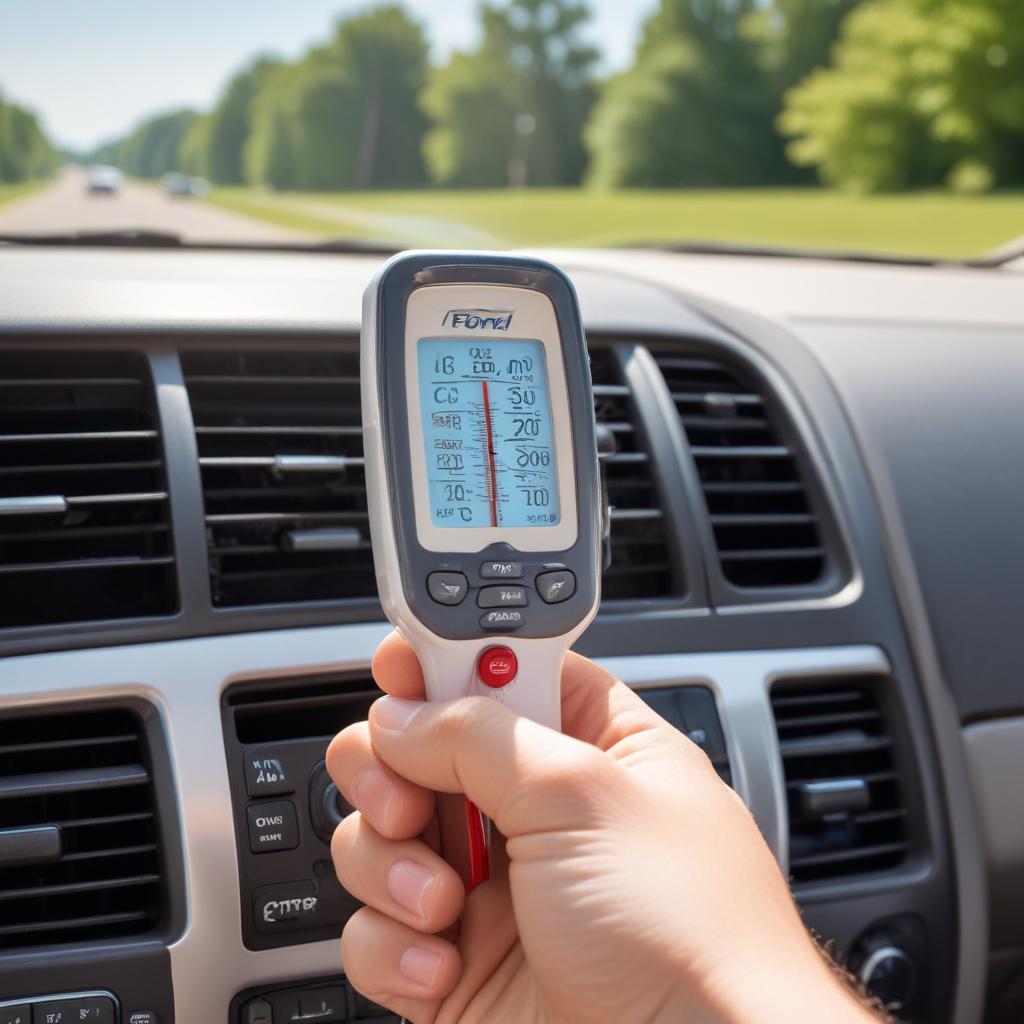
Step 7: Remove the hose, replace the cap, and drive for 10 minutes. Check vent temperature with a thermometer. Should be 40–50°F.
The honest truth: If you need to recharge, you have a leak. The recharge will last weeks to months. Eventually, you’ll need to find and fix the leak. But a $40 can buys you a whole summer sometimes.
FAQ: Real Questions from Ford Owners
1. My Ford AC blows cold only when I’m driving. Why?
Your condenser needs airflow. At idle, the cooling fan should pull air through the condenser. If the fan isn’t running, you’ll only get cold air at highway speeds. Check your cooling fan operation. Also make sure the condenser isn’t clogged with bugs or leaves.
2. Can I add refrigerant myself or do I need a license?
Anyone can buy R134a (older Fords) without a license. R1234yf (2015+ Fords) requires a license in some states, but many auto parts stores still sell it over the counter to consumers. That said, the R1234yf recharge kits cost $150–250 — often cheaper to pay a shop $200 to do it properly.
3. Why does my Ford Explorer rear AC blow warm but front is cold?
The rear AC system has its own expansion valve and blend door actuator. On Explorers, the rear actuator fails often. Access it by removing the rear passenger side trim panel (behind the third row). YouTube has guides. The part is $25–40.
4. My Ford AC makes a hissing noise behind the dashboard. Is that normal?
A slight hiss when you first turn on AC is normal (refrigerant moving through the expansion valve). A constant hiss or gurgling sound means low refrigerant — you have a leak. The hiss is air or moisture in the system. Recharge and monitor.
5. How much does a Ford AC diagnostic cost at a dealer?
Dealers charge $150–250 just to look at it. Independent shops charge $80–150. Many shops waive the diagnostic fee if you approve the repair. Always ask before dropping off your Ford.
6. Can a dirty cabin air filter really cause warm AC?
No — but it causes low airflow. Your AC can be ice cold, but if almost no air comes out of the vents, it feels warm. Always check the cabin filter first. It’s the cheapest and easiest maintenance item on your Ford.
7. My 2018 F-150 AC works then stops working randomly. What’s wrong?
That’s a failing compressor clutch. The electromagnetic coil that pulls the clutch in gets weak when hot. When it cools down, it works again. The fix is either a new clutch (if you can find one) or a whole compressor. Shops prefer replacing the whole compressor for reliability.
8. Does running the AC use more gas?
Yes, but less than you think. On a modern Ford, running the AC lowers fuel economy by 5–10%. Driving with windows down at highway speeds creates drag that can actually use more fuel than running the AC. So don’t feel guilty — stay cool.
References:
- Ford Official Support – AC & Climate Control Troubleshooting
- Consumer Reports – Car AC Not Cold? What to Check First
- EPA – Legal Refrigerant Handling and Disposal for Vehicle AC Systems
- Ford Truck Enthusiasts – AC & Heating System Forum (Real Fixes)
Summer is coming fast. Have you fixed your Ford’s AC yourself, or is it still blowing warm? Drop your year and model in the comments — we’ll help you figure out which part failed and where to start.