Ford Tire Pressure Light Won’t Turn Off? Here’s the Fix | TPMS Reset Guide
You fill your tires to the exact pressure on the door sticker. You drive for a week. The little orange horseshoe with an exclamation point is still glowing on your dashboard like an angry eye. You’ve checked the pressure four times. You’ve added air twice. The light refuses to turn off. Now you’re staring at it every single drive, wondering if you’re going crazy.
That tire pressure warning light (TPMS — Tire Pressure Monitoring System) is designed to help you. But when it stays on after you’ve fixed the problem, it becomes a nagging annoyance. The good news? Most Ford TPMS lights that won’t turn off are simple fixes. You might need to reset the system, drive a few miles to wake up a sensor, or replace a dead sensor battery. This guide walks you through exactly why that light is stuck on and how to turn it off — without a trip to the dealer.
TL;DR: Your Ford tire pressure light won’t turn off because the TPMS system needs to be reset manually, you haven’t driven enough miles for the sensors to update (drive 15–20 minutes above 20 MPH), one of the sensors has a dead battery (lifespan 5–8 years), you have a spare tire with a low sensor, or you recently had tires rotated and the system needs to relearn. First fix: drive your Ford for 15–20 minutes at highway speeds. The sensors transmit every 60 seconds when moving — they don’t update while parked. Second fix: use the TPMS reset button (on some Fords, below the steering wheel) or the dashboard menu (Settings > TPMS > Reset). Third fix: if the light is flashing for 60 seconds then stays solid, you have a dead sensor or no sensor signal. A dead sensor costs $25–50 to replace (plus $15–30 for mounting/balancing). The light will not turn off until the faulty sensor is replaced.
Key Takeaways
- Drive the car first. TPMS sensors only transmit when the wheels are moving above 20 MPH. A 20-minute drive is the most common “fix” for a light that won’t reset.
- The TPMS reset button is below the steering wheel on many Fords (2010–2016). Hold it until the horn honks and the light flashes.
- A flashing light (for 60–90 seconds) then stays solid = dead or missing sensor. Flashing means the system can’t find one or more sensors.
- TPMS sensor batteries last 5–8 years. If your Ford is 7+ years old and the light is on with correct pressures, the batteries are dying.
- The spare tire has a sensor on many Ford trucks and SUVs. If the spare is low, the light stays on.
- After rotating tires, some Fords need a TPMS relearn procedure (using a special tool or the reset button).
- Cold weather (below freezing) can temporarily lower tire pressure and trigger the light. Inflate tires — light should turn off after driving.
Ever notice your TPMS light comes on every winter, then turns off in spring? Or flashes for a minute then stays solid?
That’s your Ford’s TPMS system telling you exactly what’s wrong — if you know how to read it. A solid light means low pressure or a system fault. A flashing light (for 60–90 seconds) means a dead or missing sensor. Cold weather means lower pressure. Let’s decode what your Ford is trying to tell you.
How Your Ford’s TPMS Works (Simple Version)
Inside each tire (including the spare on many Fords) is a small TPMS sensor attached to the valve stem. It contains a pressure sensor, a tiny computer, and a battery. The sensor measures tire pressure and transmits the reading via radio signal to a receiver in your Ford. When you’re parked, the sensors “sleep” to save battery. When you drive above 20 MPH, they wake up and transmit every 60 seconds.
The light on your dashboard turns on if any tire is 25% below the recommended pressure. If the system can’t detect a sensor (dead battery, missing sensor, or signal interference), the light will flash for 60–90 seconds then stay solid.
“I’d say 40% of TPMS light complaints are simply people not driving enough after adding air. The sensors need wheel movement to update. A 5-minute drive to the grocery store isn’t enough. Take the highway for 20 minutes.” – Tire Shop Manager, 20 years
The 8 Reasons Your Ford Tire Pressure Light Won’t Turn Off
From most common to most involved. Try these in order.
1. You Haven’t Driven Far Enough (The #1 Cause)
This catches everyone. You add air to your tires. The light stays on. You assume something is broken. But the TPMS sensors only transmit when the wheels are moving above 20 MPH. Parked or slow driving — no transmission.
How to spot it: You added air to the correct pressure. You checked it with a gauge. All tires are perfect. But the light is still on. You’ve driven around the block (1–2 miles). That’s not enough.
What to do: Drive your Ford for at least 15–20 minutes at highway speeds (45 MPH or above). The sensors will wake up, measure pressure, and transmit. The light should turn off within 10–15 minutes of driving.
Why it takes that long: The sensors transmit every 60 seconds. The receiver needs multiple consistent readings to confirm the pressure is normal. If the light was on for low pressure, it needs 3–5 good readings in a row before turning off.
The fix time: 20 minutes of driving.
Pro tip: Use this as an excuse to take the scenic route home. Your light will likely turn off before you get there.
2. You Need to Use the TPMS Reset Button (On Some Fords)
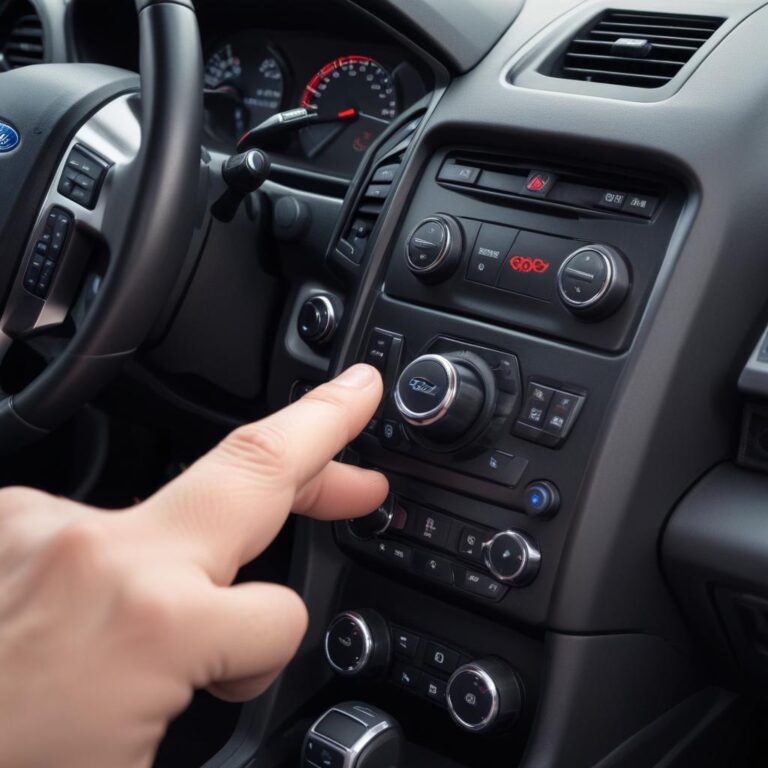
Many Ford vehicles (F-150, Explorer, Edge, Mustang from 2010–2016) have a physical TPMS reset button below the steering wheel. This button tells the system to relearn the sensor IDs. Not all Fords have one — newer Fords (2017+) use automatic relearn or dashboard menus.
How to spot it: Get under the steering wheel (where your knees would be). Look for a small button with a picture of a tire and an exclamation point, or a button labeled “TPMS” or “RESET.” It’s often near the OBD2 port or the hood release lever.
What to do (with reset button):
- Turn the ignition to ON (engine off — just the electronics).
- Press and hold the TPMS reset button until the horn honks once and the TPMS light flashes (about 5–10 seconds).
- Start the engine. Drive for 10–15 minutes. The system will relearn the sensors.
What to do (without reset button — dashboard menu):
- Press the MENU button on your steering wheel or dashboard.
- Scroll to Settings > Vehicle > TPMS (or Tire Pressure).
- Select Reset or Relearn. Confirm.
- Drive for 10–15 minutes.
The fix time: 5 minutes (reset) + 15 minutes driving.
3. One or More TPMS Sensors Has a Dead Battery (The Time Bomb)
TPMS sensors have internal batteries that last 5–8 years. They cannot be replaced separately — you replace the whole sensor. When a battery dies, the sensor stops transmitting. Your Ford’s receiver detects a missing sensor and turns on the TPMS light — usually flashing for 60 seconds, then solid.
How to spot it: You’ve checked tire pressure. All tires are correct. You’ve driven for 30 minutes. The light is still on. It might flash for 60 seconds when you start the car, then stay solid. Also, how old is your Ford? If it’s 7+ years old and you’ve never replaced TPMS sensors, one or more are likely dead.
What to do: Have the TPMS sensors diagnosed. A tire shop has a tool that can “wake up” each sensor and read its battery level, pressure, and temperature. They’ll tell you which sensors are dead. Replace them. Cost: $25–50 per sensor (aftermarket) or $40–80 (OEM) plus $15–30 per wheel for mounting and balancing. You can drive with dead sensors — the light will just stay on — but you lose low-pressure warnings.
The honest truth: When one sensor battery dies, the others are close behind. Replace all four at once. You’ll pay labor once. Doing them one by one costs more in the long run.
Pro tip: Some Ford models (especially F-150 and Super Duty) use different sensor frequencies depending on the year. The parts store will ask for your VIN to match the correct sensor.
4. Your Spare Tire Has Low Pressure (Ford Trucks and SUVs)
Many Ford F-150s, Explorers, Expeditions, and Super Duty trucks have a TPMS sensor in the spare tire. Most people never check the spare’s pressure. When it drops 25% below spec, the TPMS light comes on — and you’ve been checking the four road tires, getting frustrated, never thinking about the spare.
How to spot it: You have a Ford truck or SUV (especially F-150, Expedition, Explorer with factory spare tire carrier underneath the bed or in the cargo area). All four road tires are at correct pressure. Light stays on. The spare looks low (or hasn’t been checked in years).
What to do: Lower the spare tire (on F-150s, there’s a hole in the rear bumper where you insert the jack handle to lower the spare). Check its pressure. Inflate it to the pressure listed on the door sticker (spare pressure is often higher — 60 PSI on some trucks). Drive for 15 minutes. The light should turn off.
The fix time: 15 minutes to lower, inflate, and raise the spare.
5. Aftermarket Wheels or Tires Without Sensors (The Missing Sensor Problem)
If you bought aftermarket wheels or had tires installed at a shop that didn’t transfer your TPMS sensors, your Ford has no sensors in one or more wheels. The receiver sees a missing sensor and turns on the light — usually flashing then solid.
How to spot it: Did you recently get new wheels or tires? Did the TPMS light come on right after? Look at your valve stems. TPMS sensors have metal valve stems (or rubber stems with a metal base). Non-TPMS valve stems are all rubber. If you have rubber-only stems, you have no sensors.
What to do: Install TPMS sensors in those wheels. If you still have your old sensors, a tire shop can transfer them ($5–10 per wheel to dismount, transfer, remount, balance). If you need new sensors, cost $25–50 each plus labor.
The honest truth: Many shops will try to sell you new sensors even if your old ones are fine. Ask them to test the old sensors first with their tool.
6. The TPMS Sensor Is Faulty or Damaged (Not Just Battery)
A sensor can fail from physical damage (pothole impact, tire machine mishap, corrosion) even if the battery is fine. The internal circuit board can crack. The pressure transducer can fail. The sensor might transmit garbage data that the Ford receiver ignores.
How to spot it: A tire shop’s TPMS tool shows the sensor has a good battery but no pressure reading, or the sensor ID is corrupted. The tool won’t “wake up” the sensor. Or the sensor responds but the pressure reading is wildly wrong (like 0 PSI or 99 PSI).
What to do: Replace the damaged sensor ($25–50 plus labor). If the sensor was damaged during tire installation, the shop may cover it — ask.
7. Radio Frequency Interference (The Rare One)
TPMS sensors transmit on a specific radio frequency (usually 315 MHz for Ford). A powerful radio transmitter nearby (like a CB radio, amateur radio, or even a faulty LED light driver) can drown out the sensor signals. Your Ford’s receiver can’t hear the sensors, so the light flashes.
How to spot it: The TPMS light turns on in certain locations (near a specific building, tower, or parking lot) but turns off when you drive away. Or the light is intermittent for no apparent reason. All sensors test fine.
What to do: Nothing — it’s environmental. Drive away from the interference. The light will turn off. If it happens consistently in your own driveway, check for a faulty LED bulb, power supply, or radio transmitter nearby.
8. The TPMS Receiver Module Is Failing (The Expensive One)
This is rare. The actual module in your Ford that listens for TPMS signals can fail. It won’t detect any sensors — the light will flash and stay solid permanently.
How to spot it: You have new sensors in all four tires (and spare, if equipped). A tire shop’s TPMS tool shows all sensors are transmitting strong signals. But your Ford doesn’t respond — no matter how long you drive. The receiver is dead.
What to do: Replace the TPMS receiver module. Part cost $150–400 depending on your Ford model. Dealer-only programming is often required. Total cost $400–800. The honest truth: on a 10+ year old Ford, it’s often not worth fixing. Live with the light or cover it with tape.
What Does a Flashing TPMS Light Mean? (Important Distinction)
This is critical. Ford TPMS lights behave differently depending on the problem.
- Solid light that comes on and stays on: Low tire pressure. Check your tires. Add air. Drive. Light should turn off.
- Light flashes for 60–90 seconds when you start the car, then stays solid: TPMS system fault — a dead sensor, missing sensor, or receiver problem. The system is telling you it can’t talk to one or more sensors.
- Light flashes constantly (never stops flashing): Severe system malfunction. Rare. See a dealer.
If your light is flashing, a dead sensor battery is the most likely cause.
Comparison: TPMS Light Behavior and Causes
| Light Behavior | Most Likely Cause | Fix | DIY? |
|---|---|---|---|
| Solid on, turns off after adding air and driving | Low pressure | Add air, drive 20 minutes | Yes |
| Solid on, doesn’t turn off after adding air | Haven’t driven enough, or spare tire low | Drive 30 minutes, check spare | Yes |
| Flashes 60 sec then solid, aftermarket wheels installed | Missing sensors in new wheels | Install sensors in all wheels | No (shop) |
| Flashes 60 sec then solid, Ford 7+ years old | Dead sensor battery(s) | Replace sensors (recommend all 4) | No (shop) |
| Flashes 60 sec then solid, came on after pothole | Damaged sensor | Replace damaged sensor | No (shop) |
| Light on after tire rotation, pressures good | Need TPMS relearn | Use reset button or drive | Yes |
| Light on only when parked in one location | Radio interference | Drive away | Yes |
| Light flashing constantly | Receiver module failure | Replace receiver module | No (dealer) |
Real Story: How a $300 Diagnosis Turned Into a $0 Drive Around the Block
My uncle has a 2015 Ford F-150. His TPMS light came on. He checked the pressures — all were fine. He took it to a tire shop. They diagnosed “bad sensors” and quoted $400 to replace all four. He almost said yes.
I asked him, “Did you drive it after you checked the pressures?”
“Yeah, I drove it home. Maybe a mile.”
“Drive it on the highway for 20 minutes.”
He was skeptical but did it. He got on the interstate, drove for 15 minutes. The light turned off before he reached the next exit. He called me, laughing. “That was a $400 drive around the block.”
The tire shop was going to sell him sensors he didn’t need. The sensors were fine — they just needed wheel movement to wake up and transmit.
“I’ve seen customers tow their car to the shop for a TPMS light. The towing cost more than the problem. Most TPMS lights just need a good drive. Sensors sleep when parked. Wake them up by driving. It’s that simple.” – ASE Master Technician
How to Check Which TPMS Sensor Is Dead (Without a Shop)
You can’t read sensor batteries without a special tool. But you can sometimes identify a dead sensor by process of elimination.
Method 1 — Lower pressure in one tire. Lower one tire by 5–7 PSI. Drive for 10 minutes. Does the TPMS light now indicate a specific low tire? (Some Fords show individual pressures on the dash). If yes, that sensor is alive — it reported the low pressure. Repeat for other tires. The tire that doesn’t trigger a low-pressure reading has a dead sensor.
Method 2 — Use a TPMS activation tool. These tools cost $60–150 on Amazon. They wake up each sensor and display battery life, pressure, and sensor ID. Worth it if you plan to keep your Ford for years.
Method 3 — Take it to a tire shop. Most shops will scan your TPMS sensors for free or for $10–20. They’ll tell you exactly which sensors are dead and what the battery levels are.
Where Is the TPMS Reset Button on My Ford?
This varies by year and model.
| Ford Model | Years | Reset Button Location |
|---|---|---|
| F-150 | 2010–2016 | Below steering wheel, near OBD2 port |
| F-150 | 2017–2024 | No physical button — use dashboard menu |
| Explorer | 2011–2015 | Below steering wheel, left side |
| Explorer | 2016–2024 | Dashboard menu (Settings > TPMS) |
| Edge | 2011–2014 | Below steering wheel |
| Edge | 2015–2024 | Dashboard menu |
| Mustang | 2010–2014 | Below steering wheel |
| Mustang | 2015–2024 | Dashboard menu |
| Escape | 2013–2024 | No physical button (automatic relearn) |
| Super Duty | 2011–2016 | Below steering wheel |
| Super Duty | 2017–2024 | Dashboard menu |
No button? On newer Fords, just drive. The system automatically relearns sensor positions after rotation. No button needed.
Chart: TPMS Sensor Battery Life by Ford Model Year
This chart shows when your sensors are likely to die based on the age of your Ford.
🔋 TPMS Sensor Battery Failure Rate by Vehicle Age
Source: TPMS industry data — typical battery lifespan 5–8 years. Percentage of vehicles with at least one dead sensor.
Can You Drive With the TPMS Light On?
Yes — but with caution. The TPMS light is a warning system, not a “stop now” emergency. You can drive with it on. But you need to manually check your tire pressure every few days to ensure you don’t have a slow leak. A tire at 15 PSI (instead of 35) can overheat and blow out at highway speed.
If the light is flashing (dead sensor), the only risk is that you won’t get a warning if a tire goes low. Check your pressure manually once a week.
Some states have vehicle inspections that require the TPMS light to be off. A flashing or solid light will fail inspection in many states.
How to Replace TPMS Sensors Yourself (It’s Actually DIY-Friendly)
You don’t need a shop if you have basic tools and a tire machine? Actually, you do need a tire machine to break the bead. But you can buy a set of TPMS sensors online ($80–120 for all four) and have a local tire shop install them for $10–15 per wheel. That’s much cheaper than buying the sensors from the shop.
Step by step:
- Buy TPMS sensors that match your Ford’s frequency and model year. Use a site like RockAuto or Tire Rack. Enter your VIN to ensure compatibility.
- Bring the new sensors to a tire shop. Ask them to:
- Dismount the tires
- Remove the old sensors
- Install the new sensors (standard valve stem installation)
- Remount and balance the tires
- After installation, drive for 20 minutes to let the sensors register.
- If the light doesn’t turn off, perform a TPMS reset (button or menu).
Cost comparison:
- Shop-supplied sensors installed: $200–400 for all four.
- Your own sensors + shop labor: $80–120 (sensors) + $40–60 (labor) = $120–180. Savings of $80–200.
FAQ: Real Questions from Ford Owners
1. How long does it take for the TPMS light to turn off after adding air?
You need to drive above 20 MPH for 10–20 minutes. The sensors transmit every 60 seconds while moving. The system needs 3–5 good pressure readings in a row before turning off the light. Quick trips around the block won’t do it.
2. Can I turn off the TPMS light permanently?
Not legally or safely. You could remove the TPMS fuse, but that will turn off other systems too. You could cover the light with tape, but then you lose all low-pressure warnings. The safe answer: fix the problem.
3. How much does it cost to replace Ford TPMS sensors?
- Aftermarket sensors (DIY purchase): $20–40 each
- OEM sensors (dealer purchase): $40–80 each
- Tire shop installation (labor only): $10–20 per wheel
- Tire shop supplied and installed: $50–100 per wheel
Replace all four at once. Paying labor once is cheaper than four separate trips.
4. Why did my TPMS light come on after I rotated my tires?
Your Ford’s system stores which sensor is in which position (LF, RF, LR, RR). After rotation, the LF sensor might now be in the RR position. The system might not figure this out immediately. Drive for 20 minutes — most Fords auto-relearn. If not, use the TPMS reset button or dashboard menu.
5. My Ford TPMS light is on but all tires are at correct pressure. What now?
Check your spare tire (if equipped with a sensor). F-150s, Explorers, Expeditions, and Super Dutys have sensors in the spare. Also, drive for 30 minutes — sensors need movement to update. If the light still won’t turn off, one or more sensors may have a dead battery.
6. Does cold weather affect TPMS sensors?
Yes — for every 10°F drop in temperature, tire pressure drops about 1–2 PSI. That’s why TPMS lights often come on during the first cold snap of winter. Add air. Drive. The light will turn off. This is normal, not a sensor failure.
7. Can I replace just one TPMS sensor or do I need all four?
You can replace just one. But if your Ford is 7+ years old and one battery is dead, the others are close behind. You’ll pay the same mounting/balancing labor each time. Replace all four at once and save money long-term.
8. Why does my TPMS light flash when I start the car but then stop?
That’s the system performing a self-test. All Ford TPMS lights do this — they flash briefly at startup as part of the bulb check. If the flashing stops after 3–5 seconds, that’s normal. If it continues for 60 seconds, that’s a system fault (dead sensor).
9. Can a bad TPMS sensor cause the light to stay on even with correct pressure?
Yes — a dead or dying sensor won’t transmit at all. The receiver doesn’t know the pressure (correct or not) because it’s not getting any signal. The light will flash then stay solid. Replace the sensor.
10. Will the TPMS light turn off by itself after I fix the problem?
Yes — once the system receives several good pressure readings from all sensors while driving, the light will turn off. You don’t need to press any buttons (on most Fords). Just drive.
References
References:
- Ford Official Support – TPMS Light & Reset Instructions
- Consumer Reports – TPMS Light: What It Means and How to Fix It
- F-150 Forum – TPMS Sensor Replacement & Relearn Guides
- NHTSA – TPMS Safety & Legal Requirements by State
Is your Ford’s TPMS light stuck on like a stubborn house guest? Drop your year, model, whether it’s flashing or solid, and what you’ve tried in the comments. We’ve reset hundreds of TPMS lights and can tell you exactly how to get that light to turn off on your specific Ford.