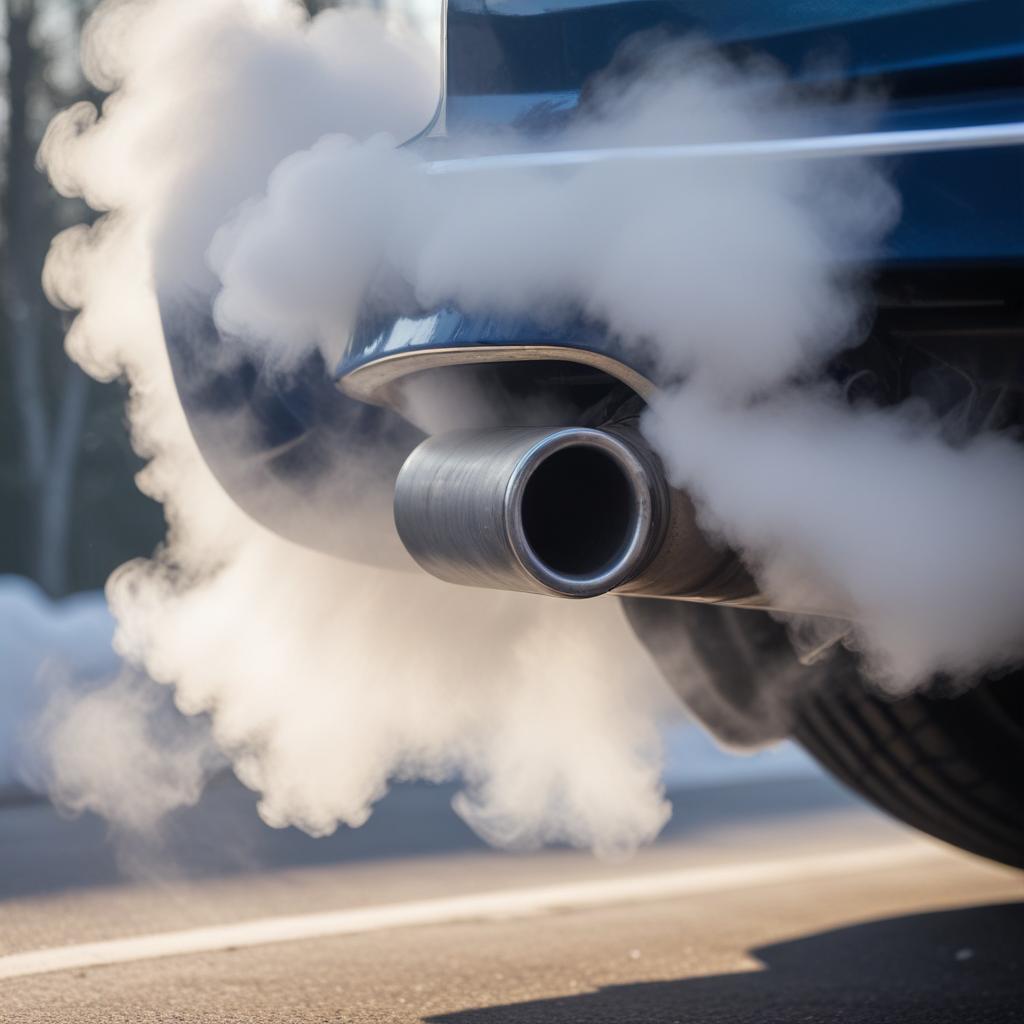
Ford Exhaust Smoke Colors Explained: White, Blue, or Black?
You’re sitting at a stoplight. You glance in your rearview mirror. A cloud of smoke is billowing out behind your Ford. The car behind you disappears in the haze. You panic. Is your engine on fire? Did you just blow a head gasket? Is this going to cost five thousand dollars?
Take a breath. Exhaust smoke looks scary, but the color tells you exactly what’s wrong – and most causes aren’t catastrophic. White smoke? Probably just condensation. Blue smoke? Burning oil – annoying but not an emergency. Black smoke? Too much fuel – cheap fix.
The short version: White smoke that disappears quickly = normal water vapor. Thick white smoke that smells sweet = blown head gasket or cracked cylinder head (expensive). Blue smoke = burning oil (valve seals or piston rings). Black smoke = too much fuel (dirty MAF, bad injector, or clogged air filter). Don’t panic at white smoke on a cold morning – that’s just your Ford breathing.
Key Takeaways (Read Your Exhaust)
- White smoke that vanishes fast = normal condensation. Especially on cold mornings.
- Thick white smoke that lingers + sweet smell = coolant burning. Head gasket or cracked head.
- Blue or gray smoke = oil burning. Valve seals or piston rings.
- Black smoke = too much fuel. Dirty MAF sensor, bad oxygen sensor, or clogged air filter.
- Puff of blue smoke on startup = valve seals leaking oil overnight – common on older Fords.
- Black smoke when accelerating hard = normal on EcoBoost engines under full throttle.
- Most smoke problems cost under $200 to fix – except head gaskets.
The Real Reason Your Ford Is Smoking
Ever notice how the smoke is worse in the morning? Or how it only happens when you floor it? Or how it smells like a campfire?
Here’s what’s happening inside your engine: Your Ford burns a mixture of air and fuel. The exhaust should be mostly invisible – just carbon dioxide and water vapor. When you see colored smoke, something extra is getting into the cylinders.
White smoke = coolant. The engine is burning antifreeze. This is bad – but not always catastrophic. On cold mornings, white “smoke” is just water vapor from condensation. Real white smoke is thick, hangs in the air, and smells sweet.
Blue smoke = oil. The engine is burning motor oil. This usually means worn valve seals or piston rings. It’s not an emergency, but you’ll need to add oil regularly until you fix it.
Black smoke = fuel. The engine is getting too much gas and not enough air. This is actually the least serious – often just a dirty sensor or clogged filter.
“Your Ford’s exhaust smoke is like a check engine light for your eyes. White means coolant. Blue means oil. Black means fuel. Learn the colors and you’ll know what’s wrong before you even pop the hood.”
Quick Diagnosis: What Color Is Your Smoke?
| Smoke Color | What’s Burning | Severity | Typical Fix Cost |
|---|---|---|---|
| White, thin, disappears fast | Water (normal) | None | $0 |
| White, thick, smells sweet | Coolant (antifreeze) | High | $1000–3000 |
| Blue-gray, smells like oil | Engine oil | Medium | $200–1500 |
| Blue on startup only | Valve seals leaking | Low to medium | $500–1000 |
| Blue all the time | Piston rings worn | High | $2000–4000 |
| Black, smells like gas | Too much fuel | Low | $50–200 |
| Black when accelerating hard | Normal on EcoBoost | None | $0 |
| Black + poor fuel economy | Dirty MAF or 02 sensor | Low | $50–150 |
⚠️ Safety reminder: Coolant smoke (sweet-smelling white) can be toxic. Don’t breathe it. If you see thick white smoke, pull over, turn off the engine, and call for a tow. Driving with a blown head gasket can destroy your engine.
White Smoke: The Cold Morning Test
This is the most common “scare” for Ford owners. You start your car on a cold morning. White vapor comes out of the tailpipe. You think your engine is dying.
The cold morning test:
Step 1: Start your cold engine. Watch the exhaust.
Step 2: Does the white “smoke” disappear within a few feet of the tailpipe? Does it evaporate quickly?
Step 3: Does it smell like anything? Water vapor has almost no smell.
Step 4: If yes to both – it’s just condensation. Normal. Every car does this when it’s cold.
Step 5: If the smoke is thick, hangs in the air, and smells sweet – that’s coolant. Pull over.
Water vapor is normal. Your engine produces water as a byproduct of combustion. When it’s cold outside, that water condenses into visible vapor. It’s not smoke. It’s steam.
More than half of all “smoke” concerns are just normal condensation. If the smoke disappears quickly and has no smell, you’re fine.
White Smoke + Sweet Smell = Head Gasket (Bad News)
This is the one that hurts. Thick white smoke that doesn’t disappear – it lingers in the air like fog. And it smells sweet, like maple syrup or burnt sugar.
What’s happening: Coolant (antifreeze) is leaking into the cylinders. The engine is burning it. This turns the coolant into white steam that pours out the tailpipe.
Other symptoms of a blown head gasket:
- Engine overheating
- Bubbles in the coolant reservoir
- Milky oil on the dipstick (looks like chocolate milkshake)
- Loss of coolant with no visible leak
- Misfire on cold start
Which Fords are most at risk:
- 5.4L V8 (2004–2010) – common head gasket failure
- 3.5L EcoBoost (2011–2016) – also common
- 6.0L and 6.4L Powerstroke – very common
What to do: Stop driving. Get it towed to a shop. A head gasket job costs $1500–3000 depending on the engine. Driving with a blown head gasket can warp the cylinder heads – then you need new heads, not just gaskets.
Can you fix it yourself? Yes, if you’re very handy. It’s a big job – intake manifold, exhaust manifolds, timing chains, cylinder heads all have to come off. Plan on a weekend or two.
Blue Smoke: Burning Oil
Blue or gray smoke means oil is getting into the cylinders and burning. The smoke has a distinct smell – like a lawnmower or a two-stroke engine.
Two common causes:
1. Valve seals (blue smoke on startup) – These are little rubber seals that keep oil from leaking down the valve stems. They get hard and brittle with age. When the engine sits overnight, oil drips past the seals into the cylinders. Start the engine – puff of blue smoke. Then it clears up.
Which Fords: Very common on 4.6L V8, 5.4L V8, and 3.0L V6 (Ranger). Usually starts around 120k–150k miles.
Fix: Replace the valve seals. This is a medium-hard DIY job. You need a special tool to compress the valve springs without removing the cylinder heads. Shop cost: $800–1200. DIY cost: $100 for seals and tool rental.
2. Piston rings (blue smoke all the time) – Piston rings seal the gap between the piston and cylinder wall. When they wear out, oil from the crankcase gets sucked up into the cylinder. The engine burns oil constantly – not just on startup.
Symptoms:
- Blue smoke all the time, especially when accelerating
- Using a quart of oil every 500–1000 miles
- Loss of power
- Failed emissions test
Fix: Engine rebuild or replacement. This is expensive – $3000–5000. On an older Ford, it might be cheaper to sell the car.
The Startup Test (Valve Seals vs Rings)
This simple test tells you which problem you have.
Step 1: Let the engine sit overnight.
Step 2: Start it in the morning. Watch the exhaust.
Step 3: If you see a puff of blue smoke that clears up in 10 seconds – valve seals.
Step 4: Start the engine. Let it warm up. Have a friend follow you.
Step 5: Accelerate hard. If blue smoke pours out during acceleration – piston rings.
Valve seals are annoying but not urgent. Piston rings mean the engine is wearing out.
Black Smoke: Too Much Fuel
Black smoke means your engine is running rich – too much gas, not enough air. The unused fuel burns black in the exhaust.
Symptoms:
- Black smoke when accelerating
- Poor fuel economy (big drop – like 20% less)
- Rough idle sometimes
- Check engine light with rich codes (P0172, P0175)
Common causes on Fords:
| Cause | Difficulty | Cost |
|---|---|---|
| Dirty MAF sensor | Easy | $10 (cleaner) |
| Clogged air filter | Easy | $15–25 |
| Bad oxygen sensor | Medium | $50–100 |
| Leaky fuel injector | Medium | $100–200 |
| Bad coolant temp sensor | Easy | $20–30 |
| Fuel pressure regulator | Medium | $50–80 |
The MAF sensor (most common): Clean it with MAF cleaner. This fixes black smoke on F-150s, Explorers, and Mustangs constantly.
The air filter: When was the last time you changed it? A clogged filter chokes the engine. It sucks harder, and the computer adds more fuel. Black smoke.
The oxygen sensor: If the O2 sensor is bad, the computer doesn’t know how much oxygen is in the exhaust. It guesses rich to be safe. Black smoke.
Black Smoke on EcoBoost (Normal)
If you have an EcoBoost engine (2.7L, 3.5L, 1.5L, 1.6L) and you floor it, you might see a puff of black smoke. This is normal.
Why it happens: EcoBoost engines use direct injection. When you floor it, the computer dumps extra fuel to cool the cylinders and prevent knock. Some of that fuel doesn’t burn completely – black smoke.
When it’s normal:
- Only when accelerating hard (full throttle)
- Smoke clears up immediately when you let off
- No smoke during normal driving
- No check engine light
When it’s a problem:
- Black smoke during gentle acceleration
- Black smoke at idle
- Constant black smoke
- Poor fuel economy
If you only see black smoke when you’re having fun, your EcoBoost is fine. It’s just doing what it was designed to do.
Which Ford Model Has Your Problem?
| Ford Model | Common Smoke Issue | Typical Fix | Estimated Cost |
|---|---|---|---|
| F-150 5.4L V8 (2004–2010) | Blue smoke on startup | Valve seals | $100 (DIY) / $1000 (shop) |
| F-150 3.5L EcoBoost | Black smoke on hard acceleration | Normal | $0 |
| F-150 5.0L V8 | White smoke (head gasket) | Head gasket | $2000–3000 |
| Mustang 4.6L V8 | Blue smoke on startup | Valve seals | $100 / $1000 |
| Mustang EcoBoost | Black smoke on acceleration | Normal | $0 |
| Explorer 3.5L | White smoke (coolant leak) | Water pump or head gasket | $1500–3000 |
| Explorer 4.0L V6 | Blue smoke on startup | Valve seals | $100 / $1000 |
| Focus 2.0L | Black smoke (MAF sensor) | Clean MAF | $10 |
| Ranger 3.0L / 4.0L | Blue smoke on startup | Valve seals | $100 / $800 |
| Powerstroke Diesel | Black smoke on acceleration | Normal (unburned fuel) | $0 |
The 5.4L V8 in F-150s and Expeditions is famous for blue smoke on startup. It’s almost always valve seals. You can drive for years like this – just check your oil.
The Oil Consumption Test (How Bad Is It?)
If you have blue smoke, you need to know how much oil you’re burning.
Step 1: Change the oil. Fill to the full mark. Write down the mileage.
Step 2: Drive normally for 1000 miles.
Step 3: Check the oil level. How much did it drop?
| Oil consumed per 1000 miles | Severity | What To Do |
|---|---|---|
| Less than 1/2 quart | Normal | Nothing – most Fords burn a little |
| 1/2 to 1 quart | Annoying | Check oil every fill-up. Fix when convenient. |
| 1 to 2 quarts | Medium | Replace valve seals or budget for engine work |
| More than 2 quarts | High | Piston rings likely. Start saving for replacement. |
Ford considers up to 1 quart per 1000 miles “normal.” I think that’s generous. But it means a little blue smoke isn’t a crisis.
What NOT to Do (Mistakes That Cost Money)
| Mistake | Why It’s Bad |
|---|---|
| Ignoring sweet white smoke | Blown head gasket leads to warped heads. New engine territory. |
| Adding thicker oil for blue smoke | 20W-50 won’t fix bad seals. It just makes cold starts harder. |
| Replacing the engine for blue smoke on startup | $4000 solution to a $200 problem. Fix the valve seals first. |
| Cleaning the MAF with brake cleaner | Destroys the sensor. Use MAF cleaner only. |
| Driving with no coolant | Engine overheats. Warps heads. Blows head gasket. $5000 mistake. |
| Believing “stop smoke” additives | They don’t work. A bottle of magic won’t fix mechanical wear. |
⚠️ Safety reminder: Coolant smoke is toxic. If you’re sitting in traffic and thick white smoke is coming into your car through the vents, pull over. Get out. Call a tow truck. Don’t breathe that stuff.
The Coolant Pressure Test (For White Smoke)
If you suspect a head gasket, do this test before you take anything apart.
What you need: Coolant pressure test kit (rent from AutoZone for free).
Step 1: Let the engine cool completely.
Step 2: Remove the radiator cap or coolant reservoir cap.
Step 3: Attach the pressure tester. Pump it up to 15–20 PSI.
Step 4: Watch the gauge. Does it hold pressure? If it drops slowly, you have a leak.
Step 5: Start the engine with the tester attached. Does the pressure spike immediately? That means combustion gases are pushing into the coolant – blown head gasket.
This test takes 10 minutes and tells you for sure if you have a head gasket problem. No guessing.
FAQ (Real Questions from Ford Owners)
1. Why does my Ford smoke white when I start it in the morning?
Probably just condensation. If the smoke clears up quickly and doesn’t smell sweet, you’re fine. Every car does this when it’s cold.
2. How much blue smoke is normal on a Ford?
None is normal. But many older Fords (especially with the 5.4L V8) burn a little oil. A puff on startup is common after 100k miles. Thick blue clouds are never normal.
3. Can a bad PCV valve cause blue smoke?
Yes. The PCV valve routes crankcase fumes back into the intake. If it’s stuck open, it can suck oil into the engine. A new PCV valve costs $10–20. Try this before doing valve seals.
4. Why does my Ford diesel blow black smoke?
Diesel engines run lean. Black smoke on a diesel means unburned fuel – usually a bad injector or turbo issue. On older diesels, a little black smoke under hard acceleration is normal.
5. My Ford smokes blue when I go downhill. Why?
Oil is sloshing forward in the engine. It’s getting past the piston rings or valve seals. This is a sign of worn rings – the engine is tired.
6. Can a clogged catalytic converter cause smoke?
No. But a bad cat can cause other problems. The smoke is coming from the engine, not the cat. Fix the smoke first.
7. Why does my Ford smoke black after I changed the oil?
You overfilled it. Extra oil gets pushed into the intake through the PCV system. Check the dipstick. Drain some oil if it’s above the full mark.
The Bottom Line (Read Your Smoke, Know Your Problem)
Here’s your game plan based on smoke color:
- White smoke that disappears quickly → normal. Drive on.
- White smoke that lingers + sweet smell → head gasket. Stop driving. Tow to shop.
- Blue smoke on startup only → valve seals. Annoying but not urgent. Fix when you have time.
- Blue smoke all the time → piston rings. Engine is wearing out. Start saving.
- Black smoke all the time → too much fuel. Clean MAF, change air filter.
- Black smoke only when flooring it → normal on EcoBoost. Enjoy the power.
Here’s the honest truth: Most exhaust smoke on Fords is either normal condensation or a cheap sensor problem. Don’t panic at the first puff of vapor on a cold morning. But don’t ignore sweet white smoke – that’s your Ford telling you something serious is wrong.
Learn the colors. Learn the smells. You’ll save yourself thousands in unnecessary repairs – and you’ll know exactly when to call a tow truck.
What color smoke does your Ford make? Have you fixed a smoke problem before? Share your story in the comments – someone else is looking at the same cloud in their mirror right now.
References: