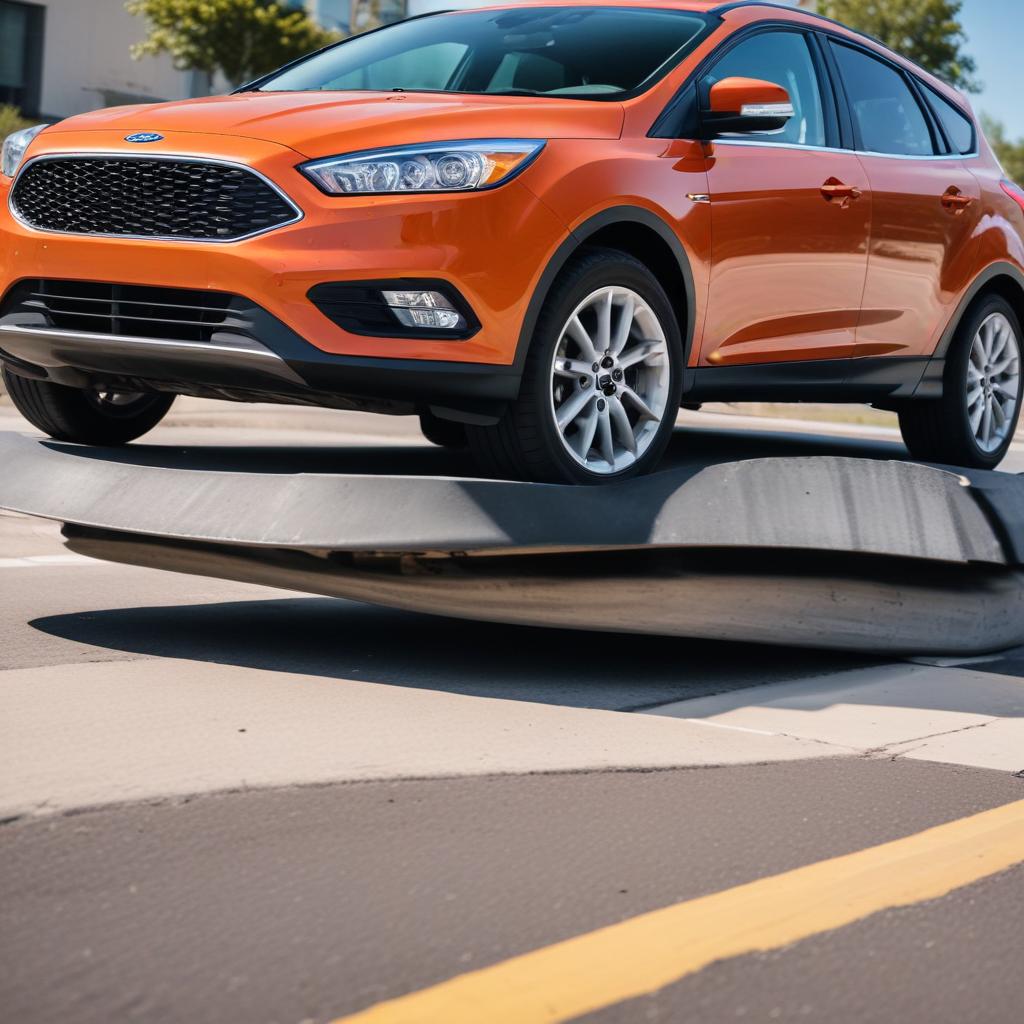
Ford Suspension Noise Over Bumps: What’s Causing It?
You’re driving through a parking lot. You hit a speed bump. THUMP. You go over a pothole. CLUNK. You turn into your driveway. GROAN. Your Ford sounds like a bowl of cereal – snap, crackle, pop – every time the road isn’t perfectly smooth. You’re not driving a beat-up old truck. Why does it sound like one?
That clunking, rattling, or squeaking over bumps is embarrassing. And worrying. You start thinking about control arms, struts, ball joints – expensive words that sound like thousand-dollar repairs. But here’s the good news: most suspension noises are caused by cheap, simple parts. Sway bar links. Sway bar bushings. End links. These are $20-50 parts that take 30 minutes to replace.
The short version: Suspension noise over bumps is almost always a worn sway bar link or sway bar bushing. Sway bar links connect the sway bar to the control arm. When they wear out, you hear a clunk or rattle over every bump. Sway bar bushings hold the sway bar to the frame. When they dry out, you hear a creaking or groaning noise. Together, they cause 70% of Ford suspension noises. Replace both for under $100 DIY. Ball joints, control arms, and shocks are less common and more expensive – but start with the sway bar parts first.
Key Takeaways
- Clunking over bumps = worn sway bar links (most common). $20-40 each, 30 minutes DIY.
- Creaking or groaning when turning or hitting bumps = dry sway bar bushings. $15-30 for a set, 1 hour DIY.
- Knocking from front end when turning = worn outer tie rod ends or ball joints. More serious.
- Rattling over small bumps (like gravel) = worn sway bar links or loose heat shield.
- Banging noise when hitting large bumps = worn struts or shocks bottoming out.
- Squeaking when going up/down driveways = dry control arm bushings.
- Most Ford suspension noise problems cost under $200 DIY – not $1000+ for new struts or control arms.
The Real Reason Your Ford Is Making Noise Over Bumps
Ever notice how the noise happens only on small bumps? Or only when you turn? Or only when the suspension compresses? Those patterns tell you exactly which part is worn.
Here’s what’s happening under your Ford: Your suspension has many moving parts – ball joints, tie rods, control arms, sway bar links, bushings. Each part has a rubber bushing or a grease-filled socket that allows movement. Over time, the rubber dries out, cracks, and wears. Metal starts contacting metal. That’s the noise.
On Ford F-150 (2004-2014) , the most common suspension noise is clunking from the front end – almost always the sway bar links. They’re plastic or metal rods with ball joints at each end. They fail around 60k-100k miles.
On Ford Explorer (2011-2019) , creaking over bumps is usually the sway bar bushings. The rubber dries out. The sway bar moves inside the bushing. Squeak, squeak, squeak.
On Ford Mustang (2005-2014) , a knocking noise when turning is often a bad outer tie rod end or ball joint. These are more serious – they affect steering and safety.
On Ford Edge and Escape , a thumping noise over large bumps (like speed bumps) is often worn struts that have lost their damping.
“Most Ford suspension noises are not dangerous – they’re annoying. Worn sway bar links won’t make your wheel fall off. But bad ball joints or tie rods will. Learn to tell the difference, or have a shop inspect it.”
Quick Diagnosis: What Does Your Ford Sound Like?
| Noise Type | When It Happens | Most Likely Cause | Urgency |
|---|---|---|---|
| Clunk or rattle over small bumps (parking lots, gravel roads) | Light bumps, uneven pavement | Sway bar links | Low – annoying but safe |
| Creaking or groaning (like an old mattress) | Going over bumps, entering driveways | Sway bar bushings (dry) | Low – just noisy |
| Thump or bang over large bumps (speed bumps, potholes) | Big hits, suspension compresses fully | Worn struts or shocks | Medium – affects ride |
| Knock when turning (especially at low speed) | Turning into parking spaces or driveways | Outer tie rod or ball joint | HIGH – affects steering |
| Rattle from rear over bumps | Any bump, especially on one side | Sway bar links or exhaust hanger | Low – check both |
| Squeak when going up/down driveway | Slow speed, suspension articulating | Control arm bushings (dry) | Low – just noisy |
| Clunk under braking | Stopping at lights, nose dives | Lower control arm bushings | Medium – braking affected |
| Metallic clicking when turning | Turning while moving | CV axle (front wheel drive) | Medium – monitor |
⚠️ Safety reminder: If your Ford pulls to one side, the steering wheel shakes, or you feel a loose or wandering steering feel – stop driving. Bad ball joints or tie rods can fail completely, causing loss of steering control. Have it towed to a shop.
Sway bar links and bushings cause nearly two-thirds of all suspension noise complaints. Start there before replacing expensive struts or control arms.
Cause #1: Sway Bar Links (Clunking and Rattling)
The sway bar (also called anti-roll bar) connects the left and right suspension to reduce body roll in corners. Sway bar links connect the ends of the sway bar to the control arms or struts. They have ball joints that wear out.
What it sounds like: A clunk or rattle over small bumps – speed bumps, potholes, parking lot pavement. The noise is often worse when only one wheel hits the bump (like a speed bump at an angle).
How to test:
Step 1: Park your Ford. Turn the wheels straight.
Step 2: Reach behind the front wheel. Find the sway bar link – a vertical rod connecting the sway bar (horizontal bar) to the control arm.
Step 3: Grab the sway bar link and shake it hard. Does it have any play? Is it loose? Can you hear a clunk?
Step 4: If it moves, wiggles, or makes noise – it’s bad.
The fix: Replace the sway bar links. Cost: $20-40 each. Time: 30 minutes per side.
Step-by-step:
Step 1: Jack up the front of your Ford. Remove the front wheels.
Step 2: Spray the nuts on the sway bar link with penetrating oil (PB Blaster).
Step 3: Use a socket and wrench (often 15mm or 18mm) to remove the nuts. You may need an Allen key or Torx bit to hold the stud from spinning.
Step 4: Remove the old link. Install the new one. Tighten the nuts.
On Ford F-150 (2004-2014), the sway bar links are plastic with metal ball studs. They fail frequently. Replace with metal aftermarket links (Moog, Mevotech) – they last longer.
Cause #2: Sway Bar Bushings (Creaking and Groaning)
Sway bar bushings are rubber cushions that hold the sway bar to the frame. They allow the sway bar to twist but keep it in place. Over time, the rubber dries out, cracks, and loses its lubrication. The sway bar rubs against the rubber – that’s the creak.
What it sounds like: A creaking or groaning noise – like an old wooden ship or a rusty gate. Often worse when going over speed bumps or entering driveways where the suspension moves slowly.
How to test:
Step 1: Park your Ford.
Step 2: Locate the sway bar bushings. They’re on the main sway bar – look for two U-shaped brackets bolted to the frame or subframe.
Step 3: Push the sway bar up and down by hand. Does it creak? Does it move freely?
Step 4: If the bushings look cracked, dry, or flattened – replace them.
The fix: Replace the sway bar bushings. Cost: $15-30 for a set of two. Time: 1 hour.
Step-by-step:
Step 1: Remove the bolts holding the U-shaped brackets over the bushings.
Step 2: Pull the old bushings off the sway bar.
Step 3: Clean the sway bar with a rag. Apply silicone grease or anti-seize to the inside of the new bushings (this prevents future squeaks).
Step 4: Install the new bushings. Reinstall the brackets. Tighten the bolts.
On Ford Explorer, the sway bar bushings are the #1 cause of creaking over bumps. Replace them with polyurethane bushings (Energy Suspension) – they last longer and reduce noise.
Cause #3: Worn Struts or Shocks (Thumping Over Big Bumps)
Struts and shocks dampen the suspension movement. When they wear out, the suspension bounces more and can bottom out over large bumps – causing a loud thump or bang.
What it sounds like: A solid thump or bang when you hit a large bump like a speed bump or deep pothole. Also, the car might bounce several times after the bump instead of settling immediately.
How to test:
Step 1: Push down hard on each corner of your Ford – front left, front right, rear left, rear right.
Step 2: Release. The car should bounce up and settle in one or two motions.
Step 3: If it bounces three or more times – the shock or strut is worn.
Step 4: Also look for oil leaking down the side of the strut or shock.
The fix: Replace the struts or shocks. Cost: $150-400 each for parts. Time: 2-4 hours per pair.
Is this DIY? Yes, but you need a spring compressor (rent from AutoZone) for struts. Shocks are easier. Watch YouTube videos for your specific Ford model.
On Ford F-150, worn struts (on 4WD) or shocks (on 2WD) are common after 80k-100k miles. The truck rides rough and thumps over bumps.
| Ford Model | Most Common Suspension Noise | DIY Fix Cost | Shop Cost |
|---|---|---|---|
| F-150 (2004-2014) | Sway bar links (plastic) – clunk over bumps | $40-60 (pair, metal aftermarket) | $200-300 |
| F-150 (2015-2024) | Sway bar bushings – creaking | $15-30 | $150-250 |
| Explorer (2011-2019) | Sway bar bushings – creaking over bumps | $15-30 | $150-250 |
| Explorer (2006-2010) | Lower control arm bushings – clunk | $80-150 (control arm) | $400-600 |
| Mustang (2005-2014) | Outer tie rod ends – knock when turning | $30-50 (pair) | $200-350 |
| Edge (2015-2024) | Sway bar links – clunk over bumps | $40-60 | $200-300 |
| Escape (2013-2019) | Strut mount bearing – creak when turning | $150-250 (strut mount) | $400-600 |
| Focus (2012-2018) | Sway bar links – rattle over gravel | $30-50 | $150-250 |
| Transit (2015-2024) | Sway bar bushings – creaking | $20-30 | $150-200 |
Cause #4: Ball Joints (Knocking + Steering Issues)
Ball joints connect the control arms to the steering knuckles. They allow the wheels to turn and move up and down. When they wear out, they make a knocking noise – and eventually, the wheel can come loose.
What it sounds like: A solid knock or clunk when going over bumps, especially large ones. May also feel loose in the steering.
How to test:
Step 1: Jack up the front of your Ford. Place jack stands under the frame.
Step 2: Grab the top and bottom of the tire (12 o’clock and 6 o’clock).
Step 3: Push and pull. Is there any play? Does it clunk?
Step 4: Have someone watch the ball joint while you push. If it moves separately from the control arm, it’s bad.
The fix: Replace the ball joint or the entire control arm (on many Fords, the ball joint is pressed into the control arm and requires special tools). Cost: $50-150 per side. Shop: $300-600 per side.
Bad ball joints are dangerous. If you have play in the wheel, get it fixed immediately.
Cause #5: Outer Tie Rod Ends (Knock When Turning)
Tie rods connect the steering rack to the wheels. Outer tie rod ends have ball joints that wear out. The first symptom is often a knock when turning – especially when turning into a parking space or driveway.
What it sounds like: A metallic knock when turning the wheel, or a clunk when going over bumps while turning.
How to test:
Step 1: Jack up the front of your Ford.
Step 2: Grab the tire at 9 o’clock and 3 o’clock.
Step 3: Push and pull. Is there any play? Does it clunk?
Step 4: Look at the outer tie rod end behind the wheel. Have someone shake the wheel while you watch. If the tie rod moves in and out of the joint, it’s bad.
The fix: Replace the outer tie rod end. Cost: $30-50 each. Time: 1-2 hours. Then get an alignment ($80-120).
Bad tie rod ends cause wandering steering and uneven tire wear. They can also fail completely, causing loss of steering control.
Cause #6: Control Arm Bushings (Squeaking + Clunk Under Braking)
Control arm bushings are large rubber cushions that mount the control arms to the frame. They absorb road shock and allow controlled movement. When they crack or separate, the control arm moves too much.
What it sounds like: A squeak when going up and down driveways. A clunk when braking. A clunk when accelerating from a stop.
How to test: With the car on the ground, have someone rock the car while you look at the control arm bushings. If the bushing is cracked, torn, or the metal sleeve is visible – replace it.
The fix: Replace the control arm bushing or the entire control arm. Cost: $80-200 per side. Shop: $400-800 per side.
On Ford Explorer (2006-2010), the rear lower control arm bushings fail frequently, causing a clunk when braking. Replace the control arms.
The Bounce Test (Struts and Shocks)
This test checks the condition of your shocks and struts.
Step 1: Push down hard on each corner of your Ford – front left, front right, rear left, rear right.
Step 2: Release quickly.
Step 3: Count how many times the car bounces.
| Result | What It Means |
|---|---|
| Settles in 1 bounce | Shocks/struts are good |
| Settles in 2 bounces | Getting weak – monitor |
| Bounces 3+ times | Shocks/struts are worn. Replace. |
If your Ford bounces like a boat on the highway, the shocks are shot. Replace them – it will transform the ride.
The “Heat Shield Rattle” (Free Fix)
Not every noise is suspension. Sometimes a loose heat shield sounds exactly like a suspension rattle.
What it sounds like: A metallic rattle over small bumps, especially at low speeds. Often comes from the rear of the vehicle.
What to do:
Step 1: Crawl under your Ford. Look for thin metal shields above the exhaust pipes and muffler.
Step 2: Tap each heat shield with a screwdriver. Do you hear a rattle that matches your noise?
Step 3: If a shield is loose, you can:
- Tighten the bolts (if any)
- Add a large fender washer under the bolt head
- Use a large hose clamp around the shield and exhaust pipe
- Remove the shield completely (safe for light driving, but avoid parking over dry grass)
This is a free fix. Check heat shields before you buy any suspension parts.
What NOT to Do
| Mistake | Why It’s Bad |
|---|---|
| Replacing struts for a sway bar link noise | $400 mistake. Diagnose first. Swap links. |
| Ignoring a knocking ball joint | Wheel can fall off. Dangerous. Fix immediately. |
| Driving with bad tie rod ends | Loss of steering control. Have it towed. |
| Spraying WD-40 on rubber bushings | WD-40 degrades rubber. Use silicone grease only. |
| Tightening sway bar links with impact gun | You’ll spin the ball stud. Use hand tools. |
| Forgetting the alignment after tie rods | Tires wear out in 1000 miles. Get alignment. |
⚠️ Safety reminder: If your steering feels loose, the car wanders on the highway, or you hear a loud clunk when turning – stop driving. Have it towed to a shop. Bad ball joints or tie rods can fail without warning.
DIY Diagnosis Flowchart
Step 1: What kind of noise?
- Clunk/rattle over small bumps → sway bar links
- Creaking over bumps → sway bar bushings
- Thump over large bumps → struts/shocks
- Knock when turning → tie rods or ball joints
- Squeak when going up driveway → control arm bushings
Step 2: Do the “shake test” for the suspected component.
Step 3: Remove the wheel for a better look.
Step 4: Replace the worn part.
Step 5: Test drive.
FAQ
1. Is it safe to drive my Ford with suspension noise?
It depends. Clunking sway bar links are annoying but safe. Creaking bushings are safe. But knocking ball joints, tie rods, or control arm bushings that cause a clunk under braking – those are dangerous. If the car feels loose or wanders, don’t drive it.
2. How much does it cost to fix suspension noise on a Ford?
DIY: $20-100 for sway bar links or bushings. $150-400 for struts. $30-80 for ball joints or tie rods. Shop: $200-600 for sway bar parts. $800-1500 for struts. $400-1000 for ball joints or control arms.
3. Can I replace just one sway bar link?
Yes. But they wear at the same rate. Replace both sides at the same time. The part is cheap ($20-40 each). The labor is the same for one or two.
4. Why does my Ford creak when I go over speed bumps?
Sway bar bushings. The rubber dries out and the sway bar rubs. Replace the bushings ($15-30). Use silicone grease on the new bushings to prevent future squeaks.
5. Why does my Ford clunk when I turn the wheel?
Outer tie rod ends or ball joints. Have them inspected immediately. This is a safety issue.
6. How long do Ford sway bar links last?
60,000-100,000 miles. On F-150 with plastic links, they may fail sooner. Replace with metal aftermarket links for longer life.
7. Can a bad CV axle cause noise over bumps?
Yes, but it’s a different noise. A bad CV axle clicks when turning – not over bumps. If you hear clicking while turning, check the CV axle. If you hear clunking over bumps, check sway bar links.
8. Why does my Ford rattle when I go over gravel roads?
Sway bar links. Small, rapid bumps cause the loose links to rattle. Replace them.
9. Will an alignment fix suspension noise?
No. An alignment adjusts angles – it does not fix worn parts. If you have noise, find and replace the worn part first, then get an alignment if needed.
10. How do I know if it’s the front or rear suspension?
Have someone drive your Ford slowly over bumps while you stand outside. Listen. Or put a phone on a tripod under the car and record. Rear noise often comes from the back seat area.
Prevention Tips
- Grease sway bar bushings when replacing – use silicone grease, not WD-40.
- Use metal sway bar links – aftermarket metal links last longer than Ford plastic ones.
- Check suspension every oil change – shake wheels, look for leaking struts.
- Don’t ignore small noises – they get worse and can damage other parts.
- Replace worn parts in pairs – both sides or both ends of the sway bar.
The Bottom Line
Here’s your game plan based on your noise:
- Clunk or rattle over small bumps → sway bar links. $20-40 each, 30 minutes DIY.
- Creaking or groaning over bumps → sway bar bushings. $15-30, 1 hour DIY.
- Thump over large bumps → struts or shocks. $150-400 each. Bounce test confirms.
- Knock when turning → tie rods or ball joints. Have professionally inspected.
- Clunk under braking → control arm bushings. Have professionally inspected.
- Rattle from rear → sway bar links or loose heat shield. Check both.
Here’s the honest truth: Most suspension noises on Ford vehicles are caused by the sway bar system – links and bushings. These are cheap, easy, and safe to replace yourself. They won’t make your wheel fall off. They won’t cause a crash. They just make noise.
Don’t let a shop sell you $1000 worth of struts and control arms for a $40 sway bar link. Jack up your Ford. Shake the sway bar links. If they’re loose, replace them. If the noise goes away, you just saved $800.
And if you have a knocking ball joint or tie rod? Don’t mess around. Get it fixed. Your life is worth more than $200.
Has your Ford ever made a clunking or creaking noise over bumps? What was the fix – sway bar links, bushings, or something else? Share your story in the comments – someone else is hearing the same noise right now.
References: