Why Your Ford Makes a Clicking Noise When Turning (And How to Stop It)
You’re backing out of a parking spot. You turn the wheel all the way to the left. Click. Click. Click. You pull forward and turn right. Click. Click. Click. The faster you turn the wheel, the faster the clicking. Everyone in the parking lot is staring at you like your truck is falling apart.
That clicking sound is annoying. Embarrassing. And honestly, it makes you wonder if something expensive is about to break. Here’s the good news: that clicking is almost always one thing – a bad CV axle. And it’s not an emergency. You can drive for weeks or months like this. But you should fix it eventually.
The short version: Clicking when turning is your CV axle telling you it’s worn out. The CV joint has bearings inside a rubber boot. When the boot tears, dirt gets in, grease leaks out, and the bearings wear down. They click when you turn because they’re running dry. Replace the axle for $80–150 on most Fords. It takes 2–3 hours. Dealer wants $600–800. An independent shop charges $300–500.
Key Takeaways (Stop the Clicking)
- CV axle = #1 cause. Clicking when turning is almost always this.
- Outer CV joint clicks when turning left or right – the side opposite the noise.
- Worn wheel bearing = grinding or humming, not clicking. Different sound.
- Loose lug nuts = clicking that changes speed with wheel rotation. Check them first.
- Stone in tire tread = clicking that matches wheel speed. Pull it out.
- CV boot tear – look for black grease sprayed inside your wheel well.
- Drive on a bad CV joint too long and it can fail completely – then you’re towed.
The Real Reason Your Ford Clicks When Turning
Ever notice how the clicking gets faster when you turn sharper? Or how it only happens when you’re moving, not when you’re parked and turning the wheel?
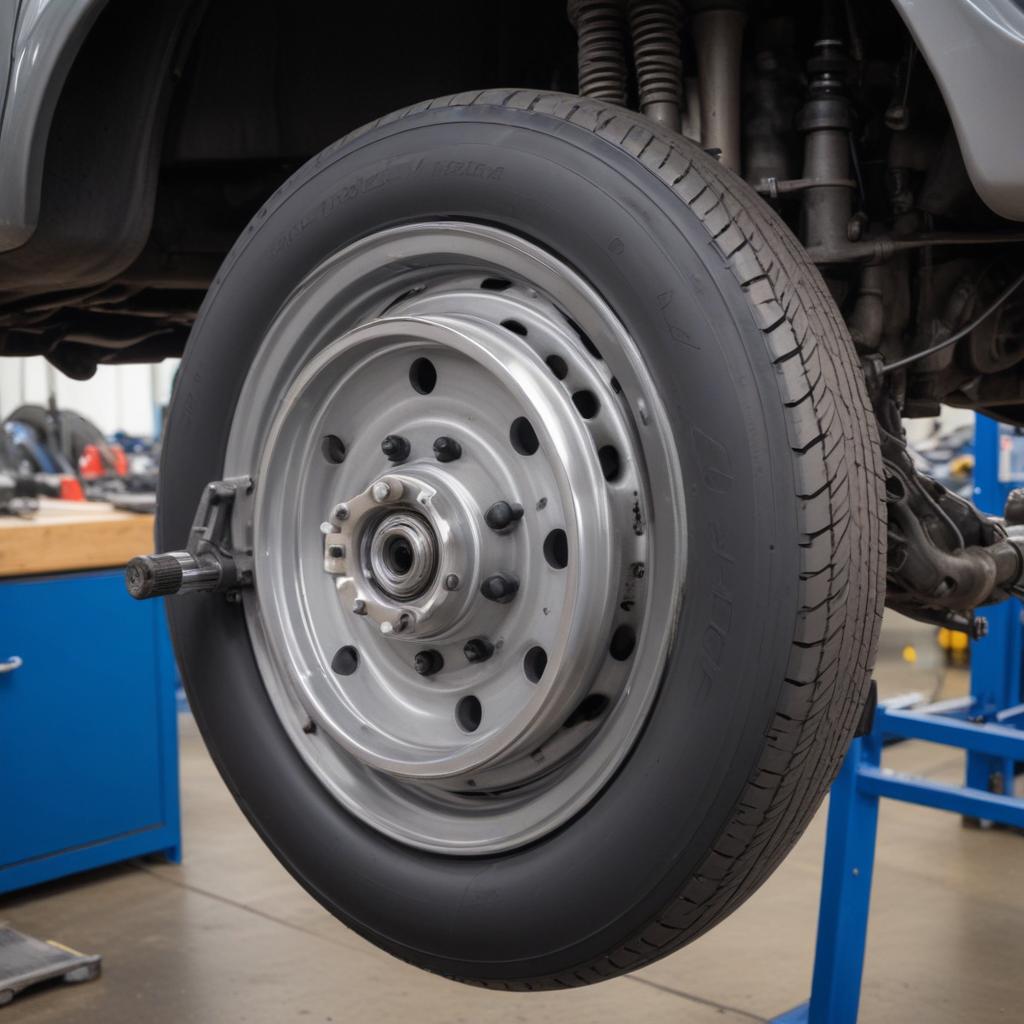
Here’s what’s happening: Your front wheels are connected to the transmission by CV axles (Constant Velocity axles). They look like metal rods with ribbed rubber boots on each end. Inside those boots are bearings that let the axle bend and rotate at the same time – so your wheels can turn left and right while also spinning.
On Ford F-150s with four-wheel drive, the front CV axles are heavy-duty. They usually last 150k–200k miles. But the rubber boots can tear earlier – from road debris, age, or off-road use. Once the boot tears, grease leaks out. Dirt and water get in. The bearings grind down. When you turn, they slip and click.
On Ford Explorers and Edges (front-wheel drive or all-wheel drive), the CV axles are smaller and wear faster – sometimes as early as 80k–100k miles.
On Ford Mustangs – rear-wheel drive cars don’t have front CV axles. Clicking when turning on a Mustang is usually a bad wheel bearing or something stuck in the tire.
“The CV axle is one of those parts that gives you plenty of warning before it fails. That clicking sound is it waving a red flag. You can ignore it for a while – but eventually the joint will come apart. And then your car isn’t going anywhere.”
Quick Diagnosis: What Does Your Clicking Sound Like?
| Symptom | What’s Likely Wrong | Urgency |
|---|---|---|
| Clicking when turning left | Right outer CV joint failing | Low – fix within months |
| Clicking when turning right | Left outer CV joint failing | Low – fix within months |
| Clicking when driving straight | Inner CV joint or wheel bearing | Medium – check soon |
| Clicking changes with wheel speed | CV joint issue – faster turns = faster clicks | Low |
| Grinding or humming when turning | Wheel bearing, not CV joint | Higher – can fail suddenly |
| Clicking when parked and turning wheel | Steering rack or tie rod – not CV axle | Medium – get checked |
| Clicking from one wheel only | That wheel’s CV axle | Low |
⚠️ Safety reminder: A CV joint can fail completely. If it does, you lose power to that wheel (on FWD/AWD) or the axle can come apart and damage other parts. You’ll hear a loud bang and the car won’t move. Fix it before that happens.
The CV Axle Test (Find the Bad Side)
This test tells you exactly which CV axle is bad.
Step 1: Find an empty parking lot.
Step 2: Turn the steering wheel all the way to the left.
Step 3: Drive slowly in a circle. Listen for clicking.
Step 4: Turn the steering wheel all the way to the right.
Step 5: Drive slowly in a circle the other way. Listen.
The rule:
- Clicking when turning left = right CV axle is bad
- Clicking when turning right = left CV axle is bad
Why? When you turn left, the right wheel is on the outside of the turn. It rotates faster and bends more. That’s when the bad joint acts up.
If both sides click in both directions, both CV axles are bad. Replace them in pairs.
Bad CV axles cause more than two-thirds of all clicking-when-turning complaints. If your Ford clicks in turns, start here.
The CV Boot Check (Look for Grease)
Before you hear clicking, you might see the problem. Crawl under your Ford or turn the wheels all the way and look behind them.
What you’re looking for: Rubber boots on the axles (one near the wheel, one near the transmission). They should be intact and not leaking.
Signs of a bad boot:
- Black grease sprayed all over the inside of your wheel well
- The boot is torn, cracked, or missing a clamp
- Grease is dripping onto the ground
- The boot is dry and cracked – failing soon
What to do: If the boot is torn but you don’t hear clicking yet, you might save the axle. Clean it out, pack new grease in, and install a new boot. Cost: $20–30 for a boot kit. Time: 1–2 hours.
If you already hear clicking, the joint is damaged. Replace the whole axle.
The Stone in Tire (Free Fix – Check First)
Before you spend any money, do this simple check. You’ll feel silly if you replace an axle for a rock.
Step 1: Look at your tires. Spin each wheel slowly.
Step 2: Look for a small stone or piece of gravel stuck in the tread.
Step 3: If you find one, pry it out with a screwdriver.
Step 4: Drive the car. Is the clicking gone?
Stones in tires make a clicking sound that matches wheel speed – just like a bad CV joint. But the clicking happens when driving straight, not just when turning. Check this first.
The Loose Lug Nuts (Dangerous – Check Immediately)
This one is rare but serious. If you recently had your wheels off (tire rotation, brake job, flat repair), a technician might have forgotten to tighten the lug nuts.
Symptoms:
- Clicking when turning and sometimes when driving straight
- Vibration in the steering wheel
- The wheel feels loose when you shake it
What to do: Stop immediately. Check every lug nut on every wheel. Tighten them with a lug wrench to 100 ft-lbs (or as tight as you can by hand). Drive slowly to a shop and have them re-torqued.
Loose wheels are dangerous. The wheel can fall off. Don’t ignore this.
Which Ford Model Has Your Problem?
| Ford Model | Drive Type | Most Common Cause | DIY Difficulty | Part Cost |
|---|---|---|---|---|
| F-150 4WD (2009–2024) | Four-wheel drive | Front CV axle (outer joint) | Medium | $80–150 |
| F-150 RWD | Rear-wheel drive | No front axles – check wheel bearing | Medium | $150–250 |
| Explorer AWD | All-wheel drive | Front CV axle | Medium | $80–120 |
| Edge AWD | All-wheel drive | Front CV axle | Hard (tight space) | $80–120 |
| Escape AWD | All-wheel drive | Front CV axle | Medium | $70–100 |
| Mustang | Rear-wheel drive | Wheel bearing, not CV axle | Medium | $150–250 |
| Transit Connect | Front-wheel drive | Front CV axle | Medium | $80–120 |
| Focus / Fusion FWD | Front-wheel drive | Front CV axle | Easy | $60–90 |
On rear-wheel drive Fords like the Mustang, there are no front CV axles. Clicking when turning is usually a bad wheel bearing. That’s a different repair – grinding or humming sound, not clicking.
Step-by-Step: Replace a CV Axle (F-150 4WD)
This is the most common CV axle replacement on Ford trucks. You can do this in a driveway.
What you need: New CV axle ($80–150), 36mm socket (for axle nut), breaker bar, jack and jack stands, pry bar, hammer, 2–3 hours.
Step 1: Loosen the axle nut while the wheel is on the ground. Use a breaker bar – it’s tight.
Step 2: Jack up the truck. Remove the wheel.
Step 3: Remove the axle nut completely. It might need an impact gun.
Step 4: Remove the lower ball joint nut. Separate the ball joint with a pry bar or ball joint tool.
Step 5: Pull the steering knuckle outward. The axle will slide out of the hub.
Step 6: Pry the inner end of the axle out of the differential. A pry bar between the axle and transmission works.
Step 7: Install the new axle. Push it into the differential until it clicks.
Step 8: Slide the outer end into the hub. Reinstall the ball joint.
Step 9: Put the axle nut on loosely. Install the wheel. Lower the truck.
Step 10: Tighten the axle nut to spec (usually 250 ft-lbs – very tight). Use a torque wrench.
Tools you’ll need: A torque wrench that goes to 250 ft-lbs. Not all do. You can rent one from AutoZone.
The “Drive on It” Question (How Long Can You Wait?)
You heard the clicking. You know it’s a CV axle. How long can you drive?
Short answer: Weeks to months. But it’s a gamble.
Why you can wait: The CV joint will click for a long time before failing completely. Many people drive 5,000–10,000 miles with clicking axles.
Why you shouldn’t wait: When it fails, it fails suddenly. You’ll hear a loud bang. The car won’t move (on FWD/AWD). You’ll need a tow. And the flailing axle can damage your brake lines, ABS sensor, or transmission case.
My advice: Fix it within 3 months or 5,000 miles. If you hear grinding or the clicking gets louder, do it sooner.
The Wheel Bearing (Not Clicking – Grinding)
People confuse CV axle clicking with wheel bearing noise. Here’s how to tell them apart:
| Sound | CV Axle | Wheel Bearing |
|---|---|---|
| Type | Clicking, clicking, clicking | Grinding, humming, growling |
| When | Only when turning | Constant, gets louder when turning |
| Speed | Click speed matches wheel speed | Pitch changes with speed |
| Direction | Clicks on one side only | Louder when turning away from bad side |
| Parked test | No sound (wheels not moving) | No sound |
Wheel bearing test: Jack up the wheel. Grab it at 12 and 6 o’clock. Shake it. Feel play? Bad wheel bearing. Grab at 3 and 9 o’clock. Play there? Bad tie rod.
If you have grinding, not clicking, you probably have a bad wheel bearing. That’s a different article.
The “Boot-Only” Repair (If You Caught It Early)
No clicking yet? Just a torn boot with grease everywhere? You can save the axle.
What you need: CV boot kit ($20–30) – includes new rubber boot, grease, clamps, and sometimes new hardware.
Step 1: Remove the axle (same as above) – sorry, you still have to take it out.
Step 2: Clean all the old grease out of the joint. Use brake cleaner and rags.
Step 3: Inspect the bearings. Are they pitted, scored, or missing? If yes, the joint is damaged. Replace the whole axle.
Step 4: Pack new grease into the joint. Slide the new boot over.
Step 5: Install the boot clamps with special pliers (or zip ties in a pinch).
Step 6: Reinstall the axle.
This is messy but cheap. It takes about the same time as replacing the axle, but costs $20 instead of $100. Worth it if the joint is still good.
What NOT to Do (Mistakes That Cost Money)
| Mistake | Why It’s Bad |
|---|---|
| Ignoring the clicking for a year | The joint will fail. You’ll need a tow. |
| Replacing both axles when one is bad | Double the labor, double the cost. Replace only the bad one. |
| Using a cheap “remanned” axle | Remanufactured axles fail faster. Buy new – GSP, Trakmotive, or Ford OEM. |
| Forgetting to tighten the axle nut | The wheel can fall off. Torque it to spec. |
| Driving in 4WD with a bad CV axle | Damages the transfer case. Very expensive. |
| Spraying lubricant on the boot | Doesn’t fix anything. Grease doesn’t help a torn boot. |
⚠️ Safety reminder: When replacing a CV axle, always use jack stands. Never work under a car supported only by a jack. And when you’re done, pump the brake pedal before driving – the first press might go to the floor.
FAQ (Real Questions from Ford Owners)
1. Why does my Ford click when turning but only when it’s cold?
The grease inside the CV joint is thicker when cold. As the joint wears, cold grease can’t lubricate as well. The clicking is worse in winter. It will click warm too – you just hear it less.
2. Can I drive with a clicking CV axle on my F-150?
Yes, for a while. Many people drive thousands of miles with clicking. But if you off-road or tow heavy, fix it sooner. The extra stress can cause sudden failure.
3. How much does a mechanic charge to replace a CV axle?
Independent shop: $300–500 per axle (parts + labor). Dealer: $600–800. DIY: $80–150 for the part. It’s a good DIY job if you have basic tools.
4. Why does my Ford click when turning right but not left?
Left CV axle is bad. When you turn right, the left wheel is on the outside of the turn. It rotates faster and bends more. That’s when the bad joint acts up.
5. My Ford makes a single click when I start moving. Is that a CV axle?
Probably not. A single click when you start moving is often a worn brake pad shifting in the caliper, or a loose suspension bolt. CV axles click repeatedly, not once.
6. Can a bad CV axle affect my steering?
Not directly. The axle doesn’t steer – the tie rods do. But a failing CV joint can vibrate and shake the wheel. You might feel it in the steering wheel.
7. Why does my Ford click when turning in reverse but not forward?
The CV joint is worn on the side that gets loaded in reverse. It will start clicking forward soon. Replace it whenever you have time – no difference.
The Bottom Line (Stop That Clicking)
Here’s your game plan based on your symptoms:
- Clicking when turning left only → replace right CV axle.
- Clicking when turning right only → replace left CV axle.
- Clicking when parked and turning wheel → not CV axle. Check steering rack or tie rods.
- Grinding or humming when turning → wheel bearing, not CV axle.
- Clicking matched to wheel speed in a straight line → stone in tire or loose lug nuts. Check both.
- No clicking yet but grease everywhere → replace the boot now. Save the axle.
Here’s the honest truth: That clicking sound is your Ford telling you “fix me soon, not now.” You have time. Weeks. Maybe months. But not forever.
The CV axle is one of the most straightforward repairs on your Ford. One axle. A few bolts. A couple of hours. And you’re back to silent turns and confident driving.
Don’t let a $100 part and a Saturday morning turn into a $500 tow and an $800 shop bill. Order the axle. Watch a YouTube video for your specific Ford. Get your hands dirty. You can do this.
Has your Ford ever clicked so loud that people turned to stare? What was the fix? Share your story in the comments – someone else is hearing that same click right now.
References: