Chassis Engineering: 2025 ford bronco sport Suspension Geometry and HOSS 1.0
Ford’s Legacy of Power and Innovation: Chassis Engineering of the 2025 Bronco Sport – Suspension Geometry and HOSS 1.0
You’re staring at a 2025 Bronco Sport Badlands with the new Sasquatch package, and somewhere in the marketing materials, you see “HOSS 1.0” and “suspension geometry” thrown around—but what does any of that actually mean when you’re bouncing down a washboard road or crawling over boulders?
Here’s the reality check: the Bronco Sport isn’t just a dressed-up Escape with some plastic cladding. Underneath that boxy, retro-inspired body lives a purpose-built chassis engineered for genuine off-road duty. The High-Performance Off-Road Stability Suspension (HOSS) system forms the foundation, and for 2025, Ford has doubled down by bringing the Sasquatch package to the smaller Bronco. Understanding how this chassis works—and what the numbers actually mean—separates serious buyers from casual shoppers.
TL;DR;
The 2025 Ford Bronco Sport rides on the unibody C2 platform shared with the Ford Escape and Maverick, but with significant chassis reinforcements and suspension tuning . The HOSS 1.0 system (yes, they use the same acronym as the big Bronco) includes an independent front suspension with MacPherson struts and a multi-link rear setup with short-and-long arm geometry . For 2025, the new Sasquatch package adds Bilstein rear dampers with piggyback reservoirs, a twin-clutch rear differential, increased suspension travel, and nearly an inch of extra ground clearance . The Badlands trim with the 2.0L EcoBoost delivers 250 hp and 277 lb-ft of torque, hitting 60 mph in 5.9 seconds—genuinely quick for a compact off-roader .
Key Takeaways
- HOSS 1.0 is Real: The Bronco Sport uses a version of the HOSS suspension philosophy, with off-road-tuned geometry and increased ground clearance over the Escape
- Sasquatch Transforms It: For 2025, the Sasquatch package adds serious hardware—Bilstein rear shocks, twin-clutch rear diff, 29-inch all-terrains, and steel skid plates
- Geometry Numbers Matter: Approach angles hit 30.0 degrees on the Badlands, with breakover at 20.4 degrees and departure at 26.7 degrees—respectable for a unibody crossover
- Engine Choice Dictates Capability: The 2.0L turbo-four (250 hp) is the only way to get the full Sasquatch experience; the 1.5L three-cylinder (180 hp) is adequate for light duty but lacks grunt for serious trails
- On-Road vs. Off-Road Trade-off: The Sasquatch package stiffens the ride noticeably, but the trade-off is legitimate off-road capability that rivals the Jeep Compass Trailhawk
The Unibody Foundation: C2 Platform with Off-Road Intent
How do you build a genuine off-roader on a front-wheel-drive-based unibody platform without it crumbling on the trail?
The answer lies in strategic reinforcement and smart geometry. The Bronco Sport shares its C2 platform with the Ford Escape and Maverick, but Ford didn’t just copy-paste the suspension bits . Engineers started with the same basic architecture—MacPherson struts up front, multi-link rear—then beefed up mounting points, revised geometry, and tuned dampers specifically for off-road use.
Front Suspension: MacPherson Struts with Attitude
Up front, the Bronco Sport uses MacPherson struts with off-road-tuned springs and dampers . This is the same basic layout as the Escape, but the differences are in the details:
- Increased ride height: The Badlands trim sits 206 mm (8.1 inches) off the ground, compared to the standard Bronco Sport’s 198 mm
- Reinforced knuckles: Higher-grade cast iron knuckles handle impacts from rocks and ruts without bending
- Geometry tweaks: Control arm angles are optimized for suspension droop rather than just on-road comfort
The front suspension travel isn’t massive—this isn’t a solid-axle Jeep—but it’s sufficient for the kind of trails most owners will actually attempt. The real story is in the damping and how the suspension soaks up impacts.
Rear Suspension: Multi-Link Magic
Out back, the Bronco Sport employs a short-and-long arm (SLA) multi-link setup . This design offers several advantages for an off-road-oriented vehicle:
- Independent wheel movement: Each rear wheel can articulate independently, keeping tires in contact with uneven terrain
- Lateral stiffness: The multi-link design controls axle movement during cornering while allowing vertical compliance
- Packaging efficiency: Leaves room for a full-size spare tire underneath the cargo area
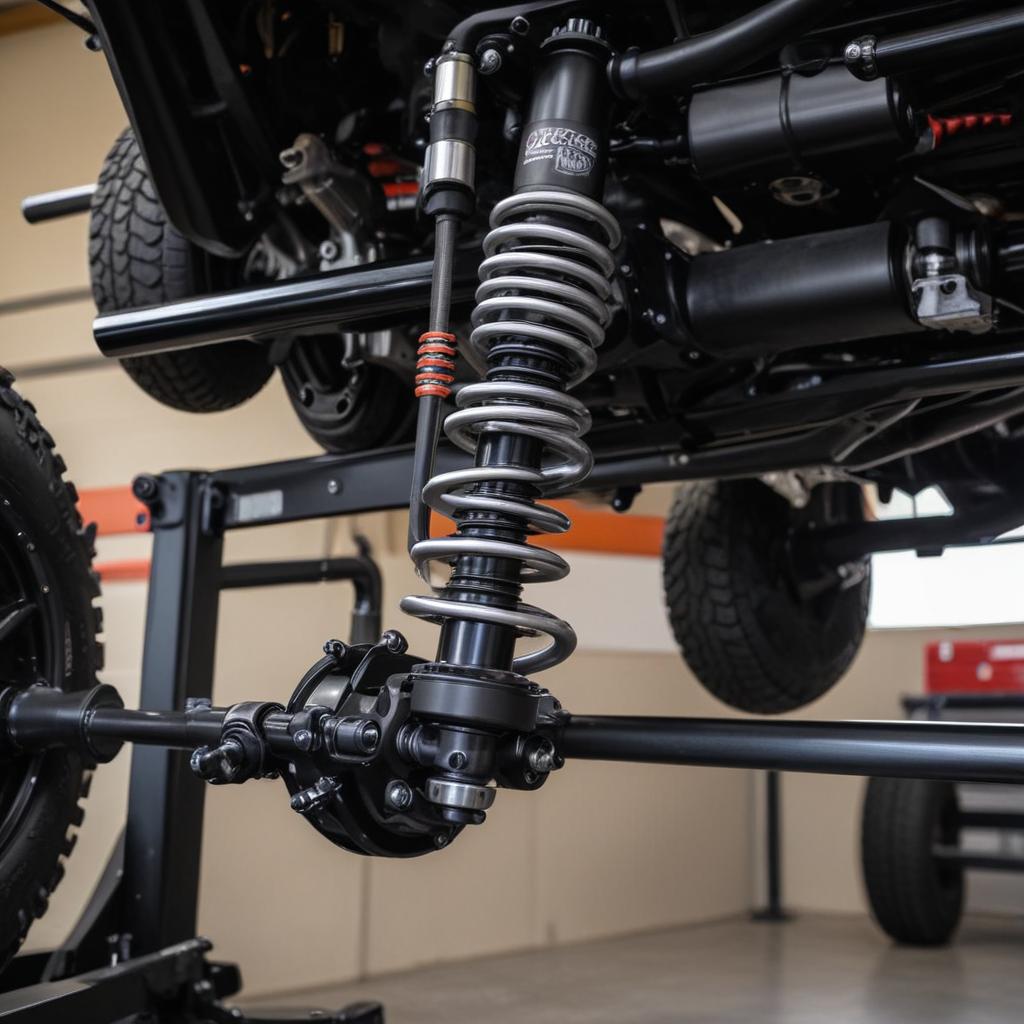
For 2025 models equipped with the Sasquatch package, the rear suspension gets Bilstein position-sensitive dampers with piggyback reservoirs . These aren’t just marketing gimmicks—the reservoirs provide additional fluid capacity, which means the shocks resist fade during extended off-road use. The position-sensitive valving means they’re compliant over small bumps but firm up as suspension travel increases, preventing harsh bottoming.
“The Bilstein rear shocks feature position-sensitive damping and pack piggyback reservoirs—real hardware that makes a difference when the trail gets rough” .
HOSS 1.0: Borrowed Tech for the Little Bronco
The big Bronco’s HOSS system gets all the attention, but the Bronco Sport has its own version. While Ford doesn’t heavily advertise “HOSS 1.0” for the Sport, the engineering philosophy carries over: High-Performance Off-Road Stability Suspension means tuning the chassis for off-road confidence without making daily driving miserable .
What HOSS Means for the Bronco Sport
On the big Bronco, HOSS 1.0 through 4.0 represent progressively more capable hardware. For the Sport, HOSS 1.0 encompasses:
- Off-road-tuned spring rates and damping
- Increased ground clearance over the Escape
- Reinforced suspension mounting points
- Skid plates on higher trims
- Electronic traction aids (torque vectoring, differential locks)
The Brazilian market version actually advertises “H.O.S.S.” as a feature, confirming that Ford considers this a legitimate part of the Bronco Sport’s identity .
The Sasquatch Package: HOSS 1.0 Plus
For 2025, Ford introduced the Sasquatch package for the Bronco Sport, available on Outer Banks and Badlands trims . This is the same name as the big Bronco’s hardcore off-road package, and while the hardware differs, the intent is identical: maximum capability from the platform.
Sasquatch Package Contents:
| Component | Specification |
|---|---|
| Rear Shocks | Bilstein position-sensitive dampers with piggyback reservoirs |
| Rear Differential | Twin-clutch unit with torque vectoring and locking capability |
| Tires | 29-inch Goodyear Territory All-Terrain (235/65R17) |
| Suspension Lift | Approximately 1-inch increase in ride height |
| Suspension Travel | +15 mm increase over standard Badlands |
| Skid Plates | Steel underbody protection |
| Front Bumper | Steel unit with integrated bull bar and recovery hooks |
| Drive Modes | Adds Rally and Rock Crawl modes |
The twin-clutch rear differential deserves special attention. This unit can vector torque between the rear wheels independently, meaning if one rear wheel loses traction, power can be sent to the wheel with grip. It also includes an electronic locking function for maximum traction in low-speed situations .
Suspension Geometry by the Numbers
Let’s get technical—but painlessly. The Bronco Sport’s suspension geometry translates into real-world capability through three critical measurements: approach angle, breakover angle, and departure angle.
2025 Bronco Sport Angles by Trim
| Trim Level | Approach Angle | Breakover Angle | Departure Angle | Ground Clearance |
|---|---|---|---|---|
| Big Bend (standard) | 22.1° | 18.6° | 30.8° | 198 mm (7.8″) |
| Big Bend (optional) | 24.1° | 21.0° | 27.3° | 224 mm (8.8″) |
| Badlands (standard) | 30.0° | 20.4° | 26.7° | 206 mm (8.1″) |
| Badlands (optional) | 31.2° | 21.7° | 27.9° | 221 mm (8.7″) |
| Sasquatch Package | Similar to optional Badlands figures | 224 mm (8.8″) |
Note: The Sasquatch package’s 1-inch lift translates to approximately 224 mm ground clearance on equipped models .
What These Numbers Mean on the Trail
- Approach angle (30.0°+): You can climb steeper inclines without smashing the front bumper. The Badlands’ 30-degree approach angle beats most compact crossovers and rivals some body-on-frame SUVs.
- Breakover angle (21.7°): This measures how steep of a crest you can cross without getting high-centered. The 21.7-degree figure on Sasquatch-equipped Badlands is respectable for a unibody vehicle with a 105-inch wheelbase.
- Departure angle (27.9°): The rear bumper clears obstacles on the way down. The Bronco Sport’s relatively short rear overhang helps here.
One forum member noted: “The angles aren’t Wrangler territory, but for a crossover that still drives nicely on pavement, they’re genuinely impressive.”
Engine and Drivetrain: Power Meets Traction
The suspension can only do so much—you need power and traction to make use of it.
2.0L EcoBoost: The Heart of the Badlands
The Badlands trim comes standard with the 2.0L turbocharged four-cylinder EcoBoost, producing 250 horsepower and 277 lb-ft of torque . This engine transforms the Bronco Sport from “adequate” to “genuinely quick.”
- 0–60 mph: 5.9 seconds
- Towing capacity: 2,700 lbs (up from 2,200 lbs on lower trims)
- Transmission: 8-speed automatic with paddle shifters
The 2.0L’s torque peak arrives at just 3,000 RPM, which means you get strong pulling power at low speeds—exactly where you need it for rock crawling and steep climbs .
1.5L EcoBoost: The Entry Point
Lower trims (Big Bend, Heritage, Free Wheeling, Outer Banks) use the 1.5L turbocharged three-cylinder, making 180 hp and 200 lb-ft of torque . This engine is adequate for daily driving and light off-road use, but it struggles compared to the 2.0L when the terrain gets serious.
- 0–60 mph: 8.2 seconds
- Towing capacity: 2,200 lbs
Car and Driver noted: “The 2.0-liter engine is what you want both on- and off-road. It’s far more responsive than the underpowered three-banger” .
G.O.A.T. Modes: Software Meets Hardware
The Bronco Sport’s Terrain Management System offers up to seven G.O.A.T. (Goes Over Any Type of Terrain) modes :
- Normal
- Eco
- Sport
- Slippery
- Sand
- Rally (new with Sasquatch)
- Rock Crawl (new with Sasquatch)
Each mode adjusts throttle response, transmission shift points, all-wheel-drive torque distribution, and traction control intervention. The new Rally mode is calibrated for loose surfaces and higher-speed off-road driving, while Rock Crawl optimizes low-speed control and differential locking.
Real-World Driving Impressions
Numbers are one thing; how does it actually feel?
On-Road Manners
The standard Bronco Sport rides reasonably well for a lifted crossover. There’s some body lean in corners—inevitable with the increased ride height—but nothing alarming. The steering is light but accurate, and the brakes (308 mm front discs) provide confident stopping power .
Add the Sasquatch package, and things change. The Bilstein shocks are firmer, and the all-terrain tires generate more road noise. Automotive Addicts noted: “The small sacrifices make the Bronco Sport one of the more off-road-capable vehicles for its class… a stiffer feeling, but not to the point of being jarring” .
Off-Road Capability
On the trail, the Sasquatch-equipped Badlands genuinely impresses. The Bilstein shocks control wheel motion effectively, keeping tires in contact with the ground. The twin-clutch rear differential works magic—you can feel it shuffling torque to the wheel with grip, often before you even notice wheel spin.
Car and Driver’s review captured it well: “We found the new Badlands Sasquatch to be enjoyable to pilot over various terrain, as it’ll happily drift around in sand at higher speeds or crawl up and down rocky passes” .
The one-pedal off-road driving mode (Trail Control) acts like low-speed cruise control—you set a speed, and the vehicle manages throttle and braking to maintain it, letting you focus entirely on steering .
Visualizing the Bronco Sport’s Capability
This chart illustrates the approach, breakover, and departure angles across different 2025 Bronco Sport configurations:
2025 Ford Bronco Sport: Off-Road Angles by Configuration
Approach, breakover, and departure angles in degrees for different Bronco Sport trims.
The Competition: How It Stacks Up
The Bronco Sport Badlands Sasquatch competes in a small but fierce segment of off-road-oriented compact crossovers.
| Model | Approach Angle | Ground Clearance | Engine | 0–60 |
|---|---|---|---|---|
| Bronco Sport Badlands Sasquatch | 31.2° | 8.8″ | 250 hp 2.0T | 5.9 sec |
| Jeep Compass Trailhawk | 30.3° | 8.5″ | 200 hp 2.4L | 8.5 sec (est) |
| Subaru Forester Wilderness | 23.5° | 9.2″ | 182 hp 2.5L | 8.0 sec (est) |
| Toyota RAV4 TRD Off-Road | 19.0° | 8.6″ | 203 hp 2.5L | 7.8 sec |
The Bronco Sport’s advantage is clear: more power and better acceleration than anything in its class, combined with genuine off-road hardware .
FAQ Section
1. What is the HOSS suspension system on the Bronco Sport?
HOSS stands for High-Performance Off-Road Stability Suspension. On the Bronco Sport, it represents the off-road-tuned suspension geometry, reinforced components, and available upgrades like Bilstein shocks that make the vehicle genuinely capable off-road .
2. What does the Sasquatch package add to the 2025 Bronco Sport?
The Sasquatch package adds Bilstein rear dampers with piggyback reservoirs, a twin-clutch rear differential with torque vectoring and locking, 29-inch Goodyear all-terrain tires, a 1-inch suspension lift, steel skid plates, a steel front bumper with bull bar, recovery hooks, and additional G.O.A.T. modes including Rally and Rock Crawl .
3. Which engine should I choose for off-roading?
The 2.0L EcoBoost four-cylinder (250 hp, 277 lb-ft) is the only choice for serious off-road use. It’s available exclusively on the Badlands trim and provides the power needed for climbing, crawling, and highway merging. The 1.5L three-cylinder (180 hp) is adequate for light duty but will struggle in demanding terrain .
4. How much ground clearance does the 2025 Bronco Sport have?
Ground clearance ranges from 198 mm (7.8 inches) on base Big Bend models to 224 mm (8.8 inches) on Badlands models with the optional suspension package or Sasquatch package .
5. What are the approach, breakover, and departure angles?
These angles measure how steep of an obstacle you can climb (approach), cross (breakover), or descend (depart) without hitting the bumpers or underbody. The Badlands Sasquatch offers 31.2 degrees approach, 21.7 degrees breakover, and 27.9 degrees departure .
6. Can I get the Sasquatch package on any Bronco Sport trim?
No, the Sasquatch package is available only on the Outer Banks and Badlands trims for 2025 . The Badlands Sasquatch includes the 2.0L engine and Bilstein rear shocks, while the Outer Banks Sasquatch uses the 1.5L engine.
7. How does the twin-clutch rear differential work?
The twin-clutch differential can independently send torque to each rear wheel. This allows for torque vectoring (improving cornering) and locking for maximum traction in low-speed off-road situations. It’s a significant upgrade over open differentials .
8. Is the Bronco Sport body-on-frame like the big Bronco?
No, the Bronco Sport uses a unibody construction on the C2 platform, shared with the Ford Escape and Maverick. It’s not designed for the same level of hard-core off-roading as the body-on-frame Bronco, but it’s significantly more capable than most unibody crossovers .
9. What’s the towing capacity of the 2025 Bronco Sport?
Towing capacity is 2,200 lbs for models with the 1.5L engine and 2,700 lbs for Badlands models with the 2.0L engine .
10. How does the Bronco Sport ride on pavement with the Sasquatch package?
The Sasquatch package stiffens the ride noticeably and adds tire noise from the all-terrain rubber. It’s not uncomfortable, but it’s firmer than the standard suspension. Most reviewers find the trade-off acceptable given the increased off-road capability .
11. What’s the 0–60 mph time for the Badlands with Sasquatch?
The Badlands with the 2.0L engine hits 60 mph in approximately 5.9 seconds, which is remarkably quick for an off-road-oriented compact SUV .
12. Does the 2025 Bronco Sport have a 360-degree camera?
Yes, a 360-degree camera system is available, and it’s standard on the Badlands trim. The system includes a split-view camera that shows the front wheels through cameras mounted under the side mirrors—useful for placing tires exactly where you want them on the trail .
References
- Autoweek: 2025 Ford Bronco Sport Adds Sasquatch Chops
- Car and Driver: 2025 Ford Bronco Sport Doubles Down on the Off-Road Lifestyle
- Automotive Addicts: 2025 Ford Bronco Sport Badlands Sasquatch Review
- Ecolo Auto: Ford Bronco Sport 2025 Specifications
- BitAuto: 2025 Ford Bronco Sport Sasquatch Details
- Mecânica Online: Ford Bronco Sport 2025 Brazil Launch (HOSS Details)
Call to Action
Are you considering a 2025 Bronco Sport with the Sasquatch package, or are you eyeing the big Bronco instead? Drop your thoughts in the comments below—and if you’ve already taken one off-road, share your experience!