
Why Your Ford Steering Feels Heavy or Hard to Turn (And How to Fix It)
You’re trying to parallel park. You turn the wheel. Nothing happens. You pull harder. The steering wheel feels like it’s connected to a concrete block. Your arms are burning. The people waiting behind you are getting impatient. Your Ford used to turn with one finger. Now it’s a workout. What went wrong?
That heavy steering is exhausting. And embarrassing. And honestly, it can be dangerous if you need to make a quick maneuver. But here’s the good news: most Ford steering problems are simple and cheap to fix. Low power steering fluid, a bad pump, or a failing belt. Not a broken steering rack or a $2000 repair.
The short version: Heavy steering on a Ford means the power steering system isn’t helping you. First, check the power steering fluid level – low fluid is the #1 cause. If it’s full, listen for a whining noise when you turn – that means a failing pump. On older Fords (pre-2011), check the serpentine belt – if it’s loose or glazed, the pump won’t spin fast enough. On newer Fords (2015+ F-150, 2011+ Explorer) with electric power steering, heavy steering means a failing electric motor or bad steering rack – those are dealer repairs. Most hydraulic steering fixes cost under $100 DIY – fluid flush, belt, or pump.
Key Takeaways
- Check power steering fluid first – low fluid = heavy steering. Top it off with Mercon V or specified fluid.
- Whining noise when turning = low fluid or failing pump. Don’t run the pump dry – it will self-destruct.
- Groaning noise at full lock = air in the system. Bleed it by turning lock to lock 10 times.
- Stiff steering only when cold = old, thick fluid. Flush and replace.
- Electric power steering (2015+ F-150, 2011+ Explorer, 2015+ Mustang) – no fluid, no pump. Heavy steering means motor or rack failure. Dealer repair ($1500-2500).
- Serpentine belt slipping – belt drives the pump. If it’s loose or glazed, pump won’t spin.
- Most hydraulic steering repairs cost under $200 DIY – not $1000 for a new rack.
The Real Reason Your Ford Steering Is Heavy
Ever notice how the steering is heavier at low speeds than on the highway? Or how it’s worse when you first start the car and gets better after driving? Or how it’s fine turning left but heavy turning right?
Here’s what’s happening: Power steering uses hydraulic pressure (or an electric motor) to multiply the force you apply to the steering wheel. When that assistance is reduced or gone, you feel every pound of effort needed to turn the tires.
On hydraulic power steering systems (most Fords before 2011-2015), a pump driven by the serpentine belt pressurizes fluid. That pressure pushes against a piston in the steering rack, helping you turn. When the fluid is low, the pump is failing, or the belt is slipping – the assist drops. You feel heavy steering.
On electric power steering systems (EPAS) (2015+ F-150, 2011+ Explorer, 2015+ Mustang, most newer Fords), an electric motor on the steering column or rack provides the assist. No fluid, no pump. When the motor fails or the control module loses data from sensors, steering gets heavy. These are more expensive to fix.
“Heavy steering is your Ford’s way of saying the power assist isn’t working. On older cars, it’s usually a $10 bottle of fluid or a $50 pump. On newer cars, it’s a computer or motor – but still fixable. Don’t ignore it – you’ll wear out your arms and your steering components.”
Quick Diagnosis: What Does Your Ford’s Steering Feel Like?
| Symptom | What’s Likely Wrong | Urgency |
|---|---|---|
| Heavy steering + whining noise when turning | Low power steering fluid or failing pump | HIGH – fix immediately. Running the pump dry destroys it. |
| Heavy steering + fluid is full | Bad power steering pump or slipping belt | Medium – fix this week |
| Heavy only when cold, normal when warm | Old, thick fluid | Low – flush and replace fluid |
| Heavy only at low speeds (parking) | Normal for electric steering? No – check assist settings | Low – could be normal on sport mode |
| Heavy steering + groaning noise at full lock | Air in the system | Low – bleed by turning lock to lock |
| Heavy steering + fluid leak under car | Power steering hose leak or rack seal failure | Medium – find and fix leak |
| Heavy steering on 2015+ F-150 | Electric power steering motor or rack failure | HIGH – dealer repair ($1500-2500) |
| Heavy steering + battery light on | Serpentine belt slipping (belt drives pump AND alternator) | HIGH – fix belt immediately |
⚠️ Safety reminder: If your steering becomes extremely heavy suddenly – like you can barely turn the wheel at all – pull over immediately. The power steering system may have failed completely. Have the vehicle towed. Do not drive a car you cannot steer safely.
Low power steering fluid causes nearly half of all heavy steering complaints on Ford vehicles. Check the fluid level before you buy any parts.
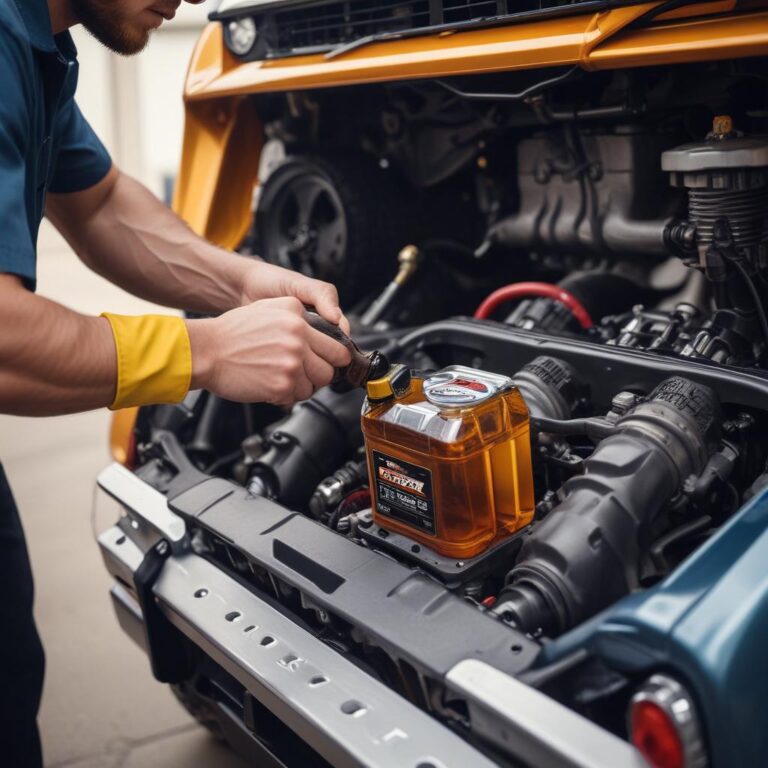
Fix #1: Check the Power Steering Fluid (Most Common)
This is the #1 cause of heavy steering on Ford vehicles with hydraulic steering. And it’s the easiest fix.
What you need: Your Ford owner’s manual, a bottle of power steering fluid (Mercon V or specified fluid), a rag, 5 minutes.
Step 1: Locate the power steering reservoir. On most Fords, it’s a small plastic container with a black cap. It says “Power Steering Fluid” or has a steering wheel icon. On F-150, it’s on the driver side near the fender. On Mustang, it’s on the passenger side near the firewall.
Step 2: Check the fluid level. Most reservoirs have marks for “Cold” and “Hot” on the dipstick or on the side of the reservoir. The engine should be off and cold for an accurate reading.
Step 3: Look at the fluid color:
- Red or pink = good condition
- Brown = old but still works
- Black and burnt smell = bad – fluid is cooked. Pump may be failing.
- Milky or foamy = air in system or wrong fluid – bleed the system.
Step 4: If the level is low, add the correct fluid. Most Fords use Mercon V or Mercon LV power steering fluid. Check your owner’s manual. Never use brake fluid, ATF that’s not specified, or generic “power steering fluid” unless it says Mercon V compatible.
Step 5: Start the engine. Turn the steering wheel lock to lock (all the way left, then all the way right) 5-10 times to bleed air. Check the level again. Add more if needed.
What the fluid level tells you:
| Level | What It Means |
|---|---|
| Normal | Fluid is fine. Problem is pump, belt, or rack. |
| Low | You have a leak. Top it off and drive. Check level again tomorrow. |
| Empty | Major leak. Fill, drive gently to a shop, or tow. |
If the fluid is low, you have a leak. The fluid didn’t evaporate – it leaked out. Find the leak (hose, pump, or rack) and fix it. Topping off is temporary.
Fix #2: Top Off Fluid and Bleed the System
If the fluid was low, you topped it off. Now you need to bleed the air out of the system. Air in the system causes heavy steering and groaning noises.
The bleed procedure:
Step 1: Start the engine. Let it idle.
Step 2: Slowly turn the steering wheel all the way to the left until it stops. Don’t force it – just until you feel resistance.
Step 3: Turn the steering wheel all the way to the right until it stops.
Step 4: Repeat this 10-15 times. You’ll see bubbles in the reservoir as air comes out.
Step 5: Check the fluid level. Add more if needed.
Step 6: Repeat until no more bubbles appear and the fluid level stays steady.
Step 7: Drive the vehicle. The steering should feel normal.
If the steering still feels heavy or the pump whines after bleeding, the pump may be damaged from running dry.
Fix #3: Find the Fluid Leak
If you had to add fluid, you have a leak. Here’s how to find it.
Step 1: Clean the power steering reservoir, hoses, pump, and steering rack with brake cleaner or degreaser.
Step 2: Add fluid to the correct level.
Step 3: Start the engine. Turn the wheel lock to lock a few times to build pressure.
Step 4: Look for the first sign of fresh fluid. The highest wet spot is the leak.
Common Ford power steering leak locations:
| Leak Location | What’s Leaking | DIY Difficulty |
|---|---|---|
| Reservoir hoses (low pressure) | Return hose cracked or clamp loose | Easy – replace hose or tighten clamp |
| High-pressure hose | Hose failed at fitting | Medium – replace hose |
| Pump front seal (leaking from pulley area) | Pump seal failed | Medium – replace pump |
| Steering rack boots (fluid dripping from rubber accordion covers) | Rack seal failed | Hard – replace rack |
| O-ring at fitting | Seal failed | Easy – replace O-ring |
The return hose (low pressure) is the most common leak on older Fords. It’s a simple rubber hose with clamps. Replace it with new hose from the auto parts store – cost: $10-20.
Fix #4: Check the Serpentine Belt (Older Fords)
The power steering pump is driven by the serpentine belt. If the belt is loose, glazed, or slipping, the pump won’t spin fast enough to create pressure.
What it sounds like: A squealing noise when you start the car or turn the wheel. Might also see the battery light flicker (alternator is on the same belt).
How to check:
Step 1: Look at the belt. Is it cracked, glazed (shiny), or frayed? Replace it.
Step 2: Press on the belt at its longest span. It should have about 1/2 inch of deflection. Too loose? The tensioner may be bad.
Step 3: Start the engine. Turn the wheel. Does the belt squeal? That’s slipping.
The fix: Replace the serpentine belt and tensioner. Cost: $30-60 for belt, $40-80 for tensioner. Time: 1 hour.
On Ford F-150, the belt tensioner wears out around 100k miles. Replace it with the belt.
Fix #5: Flush the Power Steering Fluid (Old Fluid)
If your fluid is brown or black and smells burnt, it’s old and has lost its lubricating properties. Old fluid causes heavy steering, pump whine, and pump failure.
What you need: 2 quarts of Mercon V or specified fluid, a turkey baster or fluid extractor, 30 minutes.
Step 1: Extract the old fluid from the reservoir using a turkey baster or extractor.
Step 2: Fill the reservoir with fresh fluid.
Step 3: Start the engine. Turn the wheel lock to lock 10 times.
Step 4: Turn off the engine. Extract the fluid again. It will still be dirty.
Step 5: Repeat steps 2-4 until the fluid stays red/pink.
Step 6: Fill to the proper level. Bleed the system.
You’ll use about 2 quarts to fully flush the system. This is cheap maintenance that can extend pump life.
Fix #6: Bad Power Steering Pump (Whining + Heavy Steering)
If the fluid is full, the belt is tight, but the steering is heavy and the pump whines – the pump is failing.
Symptoms of a bad pump:
- Heavy steering at low speeds (parking, turning)
- Whining noise that gets louder when you turn the wheel
- Noise is there even when fluid is full
- Sometimes fluid is foamy (air getting sucked in past seals)
The test: With the engine running and the reservoir full, have someone turn the wheel while you listen at the pump. If it whines loudly, the pump is bad.
The fix: Replace the power steering pump. Cost: $80-150 for a remanufactured pump. Time: 2-4 hours depending on the Ford model.
Step-by-step (general):
Step 1: Remove the serpentine belt.
Step 2: Remove the pulley from the pump (needs a puller tool – rent from AutoZone).
Step 3: Unbolt the pump from its bracket. Disconnect the hoses (expect fluid to drain).
Step 4: Install the new pump. Transfer the pulley using an installer tool.
Step 5: Reinstall the belt. Fill with fluid. Bleed the system.
On Ford 5.4L V8, the power steering pump is on the front of the engine, easy to reach. On 3.5L EcoBoost, it’s in a tighter spot but still DIY-friendly.
| Ford Model | Steering System | Most Common Heavy Steering Cause | DIY Fix Cost |
|---|---|---|---|
| F-150 (1997-2010) | Hydraulic | Low fluid or bad pump | $10-150 |
| F-150 (2011-2014) | Hydraulic | Power steering hose leak (common) | $20-50 (hose) |
| F-150 (2015-2024) | Electric (EPAS) | Electric rack failure – heavy steering | Not DIY – dealer ($1500-2500) |
| Mustang (2005-2014) | Hydraulic | Low fluid, bad pump, or slipping belt | $10-150 |
| Mustang (2015-2024) | Electric | Steering mode setting – normal operation | $0 – check settings |
| Explorer (2006-2010) | Hydraulic | Low fluid or bad pump | $10-150 |
| Explorer (2011-2019) | Electric | Electric rack failure – common on early models | Not DIY – dealer ($1500-2500) |
| Edge (2007-2014) | Hydraulic | Low fluid or bad pump | $10-150 |
| Edge (2015-2024) | Electric | Electric rack failure | Not DIY – dealer |
| Focus / Fiesta (2012-2018) | Electric | Electric rack or torque sensor failure | Not DIY – dealer |
Fix #7: Electric Power Steering Failure (2015+ F-150, 2011+ Explorer)
If your Ford has electric power steering (EPAS), there is no fluid, no pump, no belt. Heavy steering means the electric motor on the steering column or rack has failed, or the computer is not getting sensor data.
How to identify electric steering: Open the hood. No power steering reservoir. No pump. On F-150, look for an electric motor mounted directly to the steering rack.
Symptoms of electric steering failure:
- Heavy steering all the time (no assist)
- Steering wheel feels “notchy” or jerky
- Warning message on dash: “Steering Assist Fault” or “Service Power Steering”
- Check engine light or steering-related warning light
What to check:
Step 1: Check your Ford’s battery. Low voltage can cause electric steering to fail. Load test the battery.
Step 2: Check the steering angle sensor calibration. On some Fords, disconnecting the battery requires recalibration – turn the wheel lock to lock a few times while driving.
Step 3: Check for software updates. Ford releases updates for the Power Steering Control Module (PSCM). A dealer can update it.
The fix: If the electric rack is bad, replacement is the only option. The steering rack includes the motor and electronics. Cost: $1500-2500 for parts and labor at a dealer. Independent shops may charge less. Not a DIY job for most owners.
On 2015-2017 F-150, electric power steering rack failure is known. Ford extended the warranty on some models. Check with your dealer.
The “Sport Mode” Steering (Mustang, Focus ST, RS)
On performance Fords like Mustang, Focus ST, and Focus RS, the steering feel changes with drive mode. In Sport or Track mode, the steering gets heavier on purpose.
What it is: Not a problem – it’s a feature. The electric steering system adds more resistance to give you a sportier feel.
What to do: Check your drive mode settings. Switch to Normal or Comfort mode. Does the steering get lighter? Yes? Your Ford is fine. No problem.
This is the #1 “complaint” from new Mustang owners. The steering is supposed to be heavy in Sport mode. It’s not broken.
The Steering Rack (Hydraulic) – Last Resort
If you’ve checked the fluid, belt, and pump – and the steering is still heavy – the steering rack itself may be bad. The internal valving that directs fluid pressure to assist steering can fail.
Symptoms:
- Heavy steering in one direction only (turns easy left, hard right)
- Heavy steering that comes and goes
- Fluid is full, pump is new, belt is tight – no change
The fix: Replace the steering rack. Cost: $200-400 for a remanufactured rack (DIY), $800-1500 shop.
DIY difficulty: Hard. You’ll need to support the engine, remove the subframe or lower it, and disconnect the steering column. Then get an alignment afterward. Not for beginners.
Before replacing the rack, have a shop perform a pressure test on the pump. It could be the pump even if it’s not whining.
The “Low Tire Pressure” Check (Free)
This sounds too simple. But low tire pressure makes steering heavier – especially at low speeds. The tires have more contact with the road.
What to do: Check your tire pressures. Inflate to the pressure on the sticker inside your driver’s door jamb (usually 35-40 PSI for trucks, 32-35 for cars).
Don’t skip this. It’s free and fixes a surprising number of “heavy steering” complaints.
What NOT to Do
| Mistake | Why It’s Bad |
|---|---|
| Driving with low fluid | Destroys the pump. Metal grinds metal. $50 pump becomes $500 repair. |
| Using the wrong fluid | Wrong fluid damages seals. Pump fails. Rack leaks. |
| Letting the pump whine for months | The pump is self-destructing. Replace it now. |
| Ignoring a fluid leak | Small leak becomes big leak. Then pump runs dry. Then pump fails. |
| Replacing the rack before checking the pump | $800 mistake. Test the pump pressure first. |
| Adding stop-leak to power steering | Clogs the rack’s internal passages. Kills the system. |
| Driving with heavy electric steering | The system can fail completely. Loss of steering control. Tow it. |
⚠️ Safety reminder: If your Ford’s electric power steering fails completely, the steering becomes extremely heavy – almost impossible to turn at low speeds. At highway speeds, it’s manageable but dangerous in an emergency. Have it towed.
FAQ
1. Is it safe to drive my Ford with heavy steering?
At low speeds (parking lots), it’s hard but not dangerous. At highway speeds, you still have steering – it just takes more effort. But if the steering fails completely (electric system), you could lose control. Fix it soon. Don’t ignore it for months.
2. How much does it cost to fix heavy steering on a Ford?
Hydraulic system: DIY $10-150 (fluid, flush, belt, pump). Shop $200-600 (pump or hose). Electric system (2015+ F-150): $1500-2500 at dealer. Independent shop $1000-1800.
3. Why does my Ford steering feel heavy only when I’m parked?
That’s normal. Power steering assist is reduced at very low speeds on some electric systems. But if it’s much heavier than it used to be, check the fluid (hydraulic) or battery (electric).
4. Can a bad battery cause heavy steering on an electric Ford?
Yes. Electric power steering draws significant current. If your battery is weak, the assist motor may not get enough power. Load test your battery. Replace it if it’s old (3+ years).
5. Why does my Ford power steering whine when I turn?
Low fluid is the #1 cause. Check the level. If it’s full, the pump may be failing. A whining pump will eventually fail completely.
6. How do I know if my Ford has electric or hydraulic steering?
Open the hood. Do you see a power steering reservoir (small plastic container with a cap)? Yes = hydraulic. No = electric. Also, 2011+ Explorer, 2015+ F-150, 2015+ Mustang, most newer Fords are electric.
7. Can I add power steering fluid myself?
Yes. Use Mercon V or the fluid specified in your owner’s manual. Don’t overfill. Turn the wheel lock to lock after adding to bleed air.
8. Why is my Ford steering heavier after a battery change?
The electric power steering module may have lost its calibration. Drive the car. Turn the wheel lock to lock a few times while moving slowly. The system should recalibrate itself.
9. How long does a Ford power steering pump last?
100,000-150,000 miles. Running the pump low on fluid kills it much faster. Change your fluid every 50,000-75,000 miles.
10. Will an alignment fix heavy steering?
No. An alignment fixes pulling and uneven tire wear. It does not fix heavy steering. Heavy steering is a power assist problem, not an alignment problem.
Prevention Tips
- Check power steering fluid every oil change – catch leaks early.
- Use the correct fluid – Mercon V for most Ford hydraulic systems.
- Don’t hold the wheel at full lock – pressure builds and can blow hoses or damage the pump. Release the wheel slightly.
- Replace the serpentine belt on schedule – every 60,000-80,000 miles. A slipping belt starves the pump.
- Flush the power steering fluid every 50,000 miles – old fluid damages the pump and rack.
- Keep tires properly inflated – low tires add resistance to steering.
The Bottom Line
Here’s your game plan based on your symptoms:
- Heavy steering + whining noise → check power steering fluid first. Top it off. Find the leak.
- Heavy steering + fluid is full → bad pump or slipping belt. Check belt tension. Replace pump.
- Heavy steering + fluid is brown/black → flush the fluid. Fill with fresh Mercon V.
- Heavy steering + groaning at full lock → air in system. Bleed by turning lock to lock.
- Heavy steering on electric Ford (2015+ F-150) → check battery. Then dealer diagnostic. Electric rack failure is common.
- Heavy steering only in Sport mode (Mustang) → normal. Switch to Normal or Comfort mode.
- Heavy steering + visible fluid leak → find the leak (hose, pump, rack). Replace the leaking part.
Here’s the honest truth: Heavy steering is almost never a mystery. On hydraulic Fords, it’s low fluid. Then a bad pump. Then a slipping belt. These are cheap, easy fixes. On electric Fords, it’s a failing rack – expensive, but still fixable.
Don’t let a shop sell you a new rack without checking the simple stuff. Check the fluid. Check the belt. Listen for whining. Test the pump pressure. Ninety percent of heavy steering problems are solved for under $100.
And if you have a 2015+ F-150 with heavy steering? Get it diagnosed. Ford extended the warranty on some electric racks. You might be covered.
Has your Ford ever had heavy steering that felt impossible to turn? What was the fix – fluid, pump, belt, or electric rack? Share your story in the comments – someone else is fighting the wheel right now.
References: