Why Your Ford Won’t Start But Has Power (And How to Fix It)
You get in your Ford. Turn the key. The dashboard lights up. The radio comes on. The headlights work. Everything has power. You turn the key to start… and nothing. No crank. No click. Just silence. Or maybe a single click. But the engine doesn’t turn over. You have power. Why won’t it start?
This is one of the most frustrating car problems. Everything seems fine – lights work, radio plays, battery has juice. But the engine won’t even try to crank. Here’s the good news: when you have power but no crank, the problem is almost always simple. Starter, starter relay, neutral safety switch, or a bad ignition switch. Not an expensive computer failure.
The short version: Your Ford has electrical power but won’t crank means the starter isn’t getting the signal to spin. First, try shifting to Neutral and starting – a bad neutral safety switch is a common cause. Listen for a single loud click – that means the starter solenoid is working but the starter motor is stuck. Tap the starter with a hammer (seriously – it works). Check the starter relay and 30-amp starter fuse. Most Ford no-crank problems are the starter itself ($150-250 DIY, $400-600 shop). Not the battery. Not the alternator. Not the engine.
Key Takeaways
- Power but no crank = starter system problem, not battery or engine.
- Try starting in Neutral – bad neutral safety switch (park/neutral position switch) is very common.
- Single loud click = starter solenoid engaging but starter motor stuck. Tap the starter with a hammer.
- Rapid clicking = low battery voltage. Just because lights work doesn’t mean the battery has enough power to crank.
- Check the starter relay and 30-amp fuse – under-hood fuse box. Quick 5-minute check.
- Starter failure – most common on Ford F-150, Mustang, Explorer between 80k-150k miles.
- Most fixes cost under $300 – not a $2000 computer or engine problem.
The Real Reason Your Ford Won’t Crank
Ever notice how the problem happened right after you drove through a puddle? Or after a cold night? Or it started fine yesterday, but today – nothing?
Here’s what’s happening inside your Ford: When you turn the key to START, a small signal goes from the ignition switch to the starter relay, then to the starter solenoid, then to the starter motor. The starter motor spins the engine. That’s it. Three components.
When you have power (lights, radio, dash) but the engine won’t crank, the problem is somewhere in that starter circuit. Not the battery (it has power). Not the engine (it’s not seized – you’d have other symptoms). Not the alternator (that’s for charging).
On Ford F-150 (2004-2014) , the most common no-crank cause is the starter itself failing. The solenoid clicks, but the motor won’t spin. A sharp tap with a hammer often frees it temporarily.
On Ford Focus and Fusion , the neutral safety switch (part of the transmission range sensor) fails. The computer doesn’t know the car is in Park or Neutral, so it won’t allow starting.
On Ford Mustang , the starter relay in the under-hood fuse box fails. A $15 part. Or the ignition switch wears out.
On Ford Explorer (2011-2019) , the brake pedal switch – on push-to-start models, the computer needs to see the brake pedal pressed. No signal, no start.
“A Ford that has power but won’t crank is almost never a major failure. It’s a starter that gave up, a relay that clicked its last click, or a safety switch that forgot its job. These are $50-200 parts – not $2000 computers.”
Quick Diagnosis: What Happens When You Turn the Key?
| Symptom | What’s Likely Wrong | Fix Time |
|---|---|---|
| Silence – no click at all | No power to starter – bad relay, blown fuse, or bad ignition switch | 10-30 minutes |
| Single loud click from engine bay | Starter solenoid engaging but starter motor stuck | Tap starter with hammer – then replace |
| Rapid clicking (click-click-click-click) | Low battery voltage – lights work but not enough power to crank | Jump start, then test battery |
| All power dies when you turn key | Bad battery connection or seized engine | Check connections, feel engine |
| Starts in Neutral but not Park | Neutral safety switch (transmission range sensor) | 1-2 hours to replace |
| Nothing happens – but security light flashing | PATS anti-theft system not recognizing key | Try different key. Dealer programming |
| Click, then nothing – then works later | Starter heat soak (starter gets hot, won’t work until cool) | Common on 5.4L V8. Replace starter |
⚠️ Safety reminder: Never work on the starting system with the key in or near the ignition. The starter draws hundreds of amps. A short can cause sparks, burns, or a fire. Disconnect the negative battery terminal before touching starter wires.
The starter motor itself causes nearly half of all “power but no crank” problems. The neutral safety switch and low battery are next. Start with the simple tests before replacing parts.
Fix #1: The Neutral Safety Switch Test (Free – 10 Seconds)
This is the easiest test. Do it first.
Step 1: Get in your Ford. Turn the key to the ON position (not start).
Step 2: Press the brake pedal (if automatic). For manual transmission, press the clutch.
Step 3: Shift the gear selector from Park to Neutral.
Step 4: Try to start the engine in Neutral.
What happens:
| Result | What It Means |
|---|---|
| Starts in Neutral but not Park | Neutral safety switch (transmission range sensor) is bad or out of adjustment |
| Still won’t start in Neutral | Problem is elsewhere – starter, relay, fuse, or battery |
| Starts when you wiggle shifter | Loose or dirty neutral safety switch |
Why this works: The neutral safety switch only allows starting when the transmission is in Park or Neutral. If the switch fails or gets misaligned, the car might think it’s in Reverse or Drive. No start.
This is very common on Ford F-150 (2004-2014), Explorer, and Focus. A temporary workaround is starting in Neutral – but replace the switch eventually.
Fix #2: The “Tap the Starter” Trick (Free – Works Often)
If you hear a single loud click when you turn the key, the starter solenoid is working but the starter motor is stuck. The brushes are worn, or the armature is in a dead spot.
What you need: A hammer or a long metal rod (like a tire iron or a piece of pipe). Not a sledgehammer – just something to tap with.
Step 1: Locate the starter. On most Ford trucks and cars, it’s on the lower part of the engine, near where the engine meets the transmission. On F-150 5.4L, it’s on the passenger side, near the oil filter.
Step 2: Tap the starter body firmly with the hammer. Not hard enough to crack the housing – just a few solid taps.
Step 3: Try to start the Ford.
Result: If it starts, the starter is failing. The tap temporarily frees the stuck motor. You need to replace the starter soon – it will fail again.
This is not a permanent fix. But it can get you home or to a shop. Don’t rely on it for more than a few days.
Fix #3: The Lights Test (Battery vs Starter)
Because your lights and radio work, you assumed the battery is fine. That’s not always true. A battery can have enough power for lights but not enough to crank the engine. Cranking draws 200-500 amps. Headlights draw 10-15 amps.
The headlight test:
Step 1: Turn on your headlights. Note how bright they are.
Step 2: Have someone watch the headlights while you try to start the engine.
What the headlights do:
| Headlight Behavior | What It Means |
|---|---|
| Headlights go very dim or turn off | Battery is weak or has a bad connection. Jump start. |
| Headlights stay bright, no crank | Battery is fine. Starter or relay problem. |
| Headlights flicker rapidly | Bad battery connection or dead battery. |
The jump start test:
Step 1: Jump start your Ford from another vehicle or a jump pack.
Step 2: If it starts, your battery is weak. Have it load tested at any auto parts store (free).
Step 3: If it still doesn’t crank with a jump, the problem is the starter or relay.
Don’t skip this test. A battery can show 12.6 volts but still have no cranking amps. Load testing tells the truth.
Fix #4: Check the Starter Fuse and Relay (Free – 5 Minutes)
The starter circuit has a fuse and a relay in the under-hood fuse box. If either fails, you get silence when you turn the key.
What you need: Your Ford owner’s manual, fuse puller, 5 minutes.
Step 1: Open the under-hood fuse box (near the battery).
Step 2: Locate the starter relay. It’s a small black or grey cube. Look for “STARTER” or “ST” on the diagram.
Step 3: Locate the starter fuse. Often a 30-amp or 40-amp fuse (J-case fuse). Check your manual.
Step 4: Swap the starter relay with another relay of the same part number (like the horn relay or fuel pump relay).
Step 5: Try to start. If it works, buy a new relay ($10-15).
Step 6: Pull the starter fuse. Inspect the metal strip inside. Is it broken? Replace it ($2-5).
On Ford F-150 (1997-2003), the starter relay is often fuse #5 under the hood. On newer models, check the Power Distribution Box diagram.
Fix #5: The Brake Pedal Switch (Push-to-Start Fords)
If your Ford has push-to-start (2015+ F-150, Mustang, Explorer, Edge), the computer needs to know that your foot is on the brake pedal before it will crank. The brake pedal switch tells the computer.
Symptoms:
- Push the brake pedal, push START – nothing happens
- Push START without brake – the dash lights up but engine doesn’t crank
- No click, no sound
- Brake lights might not work
The test: Have someone stand behind your Ford. Press the brake pedal. Do the brake lights come on?
If brake lights don’t work: The brake pedal switch is bad or the fuse is blown. Replace the switch ($15-30).
If brake lights work: The computer is getting the brake signal. Problem is elsewhere – starter relay or starter.
This is a very common failure on Ford Fusion and Escape (2013-2019). The switch is easy to replace – above the brake pedal arm.
Fix #6: The Clutch Pedal Switch (Manual Transmission)
If your Ford has a manual transmission (Mustang, Focus, Fiesta, older F-150), there’s a switch on the clutch pedal that must be pressed to start the engine.
Symptoms:
- Turn key – nothing happens. No click.
- Clutch feels normal
- Works sometimes, not others
The test: Listen for a click from the clutch pedal area when you press the pedal. No click? Switch is probably bad.
Temporary workaround: On some Fords, you can bypass the switch by jumping the two wires in the connector. Not recommended long-term – the switch is there for safety.
The fix: Replace the clutch pedal switch. Cost: $15-30. Time: 20 minutes.
Fix #7: The Ignition Switch (Old Fords)
On older Ford vehicles (pre-2005), the ignition switch (the electrical part behind the key cylinder) wears out. The key turns, but the electrical contacts don’t connect.
Symptoms:
- Key turns, no crank, no click
- Other electrical accessories work (radio, lights)
- Sometimes jiggling the key makes it work
The fix: Replace the ignition switch. Cost: $30-50. Time: 1 hour.
This is more common on high-mileage Fords (150k+ miles) and work trucks. The key jiggles in the lock, wearing the contacts.
Which Ford Model Has Your Problem?
| Ford Model | Most Common No-Crank Cause | DIY Fix Cost | Shop Cost |
|---|---|---|---|
| F-150 5.4L (2004-2010) | Starter fails (heat soak) | $150-250 | $400-600 |
| F-150 5.0L/3.5L (2011-2014) | Starter or neutral safety switch | $150-250 | $400-600 |
| F-150 (2015-2024) | Brake pedal switch (push-start) or starter | $15-30 (switch) | $200-500 |
| Mustang (2005-2014) | Starter relay or starter | $15 (relay) | $150-400 |
| Mustang (2015-2024) | Brake switch or battery | $15-30 | $200-400 |
| Explorer (2011-2019) | Neutral safety switch | $80-150 | $300-500 |
| Explorer (2020-2024) | Brake pedal switch | $15-30 | $150-250 |
| Focus (2012-2018) | Clutch switch (manual) or neutral safety (auto) | $15-30 | $150-300 |
| Fusion (2010-2019) | Brake pedal switch | $15-30 | $150-250 |
| Edge (2015-2024) | Brake pedal switch | $15-30 | $150-250 |
| Escape (2013-2019) | Brake pedal switch (common failure) | $15-30 | $150-250 |
The 2004-2010 F-150 with 5.4L V8 has a very common starter failure, especially after the engine is hot (heat soak). If your truck won’t start when hot but starts fine when cold, replace the starter.
The “Heat Soak” Starter Problem (Ford 5.4L V8)
This is a specific problem on Ford 5.4L V8 engines (2004-2010 F-150, Expedition, Mustang). The starter gets heat from the exhaust manifold. When the engine is hot, the starter solenoid expands and makes poor contact. The truck won’t start until it cools down.
Symptoms:
- Drive for 20-30 minutes. Shut off the engine.
- Try to restart within 5-10 minutes – no crank or single click.
- Wait 30-60 minutes for the engine to cool – starts fine.
- More common in summer or hot weather.
Why it happens: The starter is mounted close to the exhaust manifold. Heat causes the solenoid contacts to expand and lose connection. When the starter cools, the contacts shrink back and make contact again.
The fix: Replace the starter with a new or rebuilt unit. Newer starters have better heat shielding.
Temporary workaround: Pour cold water over the starter to cool it down. Or tap the starter with a hammer. But the real fix is replacement.
| Test | What To Do | If It Works → Problem Is |
|---|---|---|
| Start in Neutral | Shift to Neutral, try to start | Neutral safety switch |
| Tap the Starter | Tap starter with hammer, try to start | Starter motor stuck |
| Headlight Test | Watch headlights while cranking | Dim/go out = weak battery |
| Jump Start | Jump from another vehicle | Weak battery |
| Relay Swap | Swap starter relay with horn relay | Bad starter relay |
| Fuse Check | Inspect starter fuse in under-hood box | Blown starter fuse |
| Brake Lights (push-start) | Check if brake lights work when pedal pressed | Bad brake pedal switch |
The Security Light (PATS Anti-Theft System)
Look at your dashboard when you turn the key. Do you see a flashing red light shaped like a car with a key? That’s the PATS system (Passive Anti-Theft). If it flashes rapidly when you crank, the computer doesn’t recognize your key.
Symptoms:
- Engine cranks but won’t start? No – PATS usually prevents cranking on most Fords, but on some models it allows cranking but no fuel. Either way, the light flashes.
- Started fine yesterday. Today – nothing.
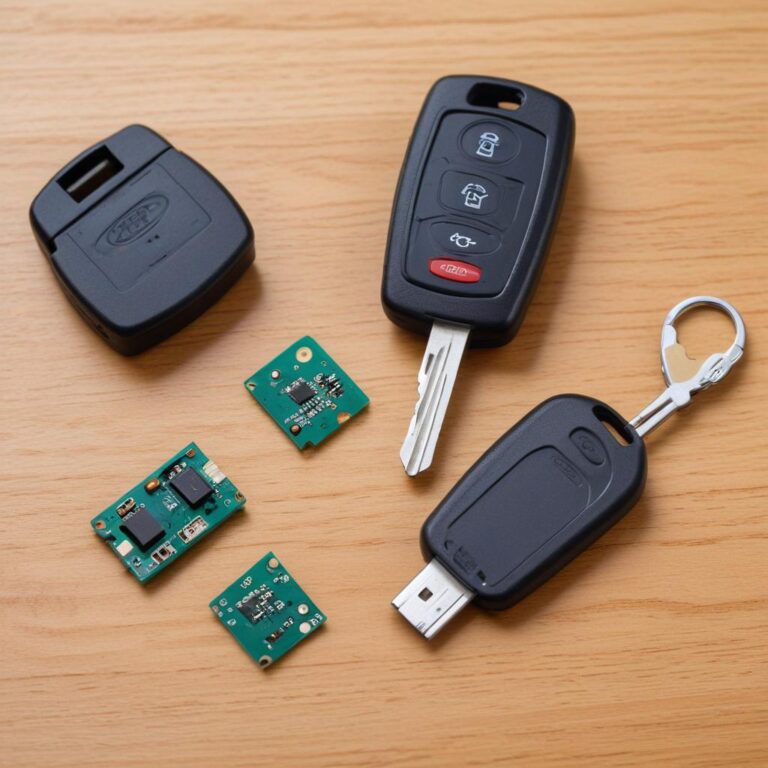
- You recently had a key copied at a hardware store (copied keys often lack the chip).
What to do:
- Try a different key if you have one.
- On push-to-start models, hold the key fob against the steering column where you would insert a key, then press START.
- If neither works, you need a dealer to program new keys ($150-250).
This is common on Ford Focus, Fiesta, Fusion, and Escape. People get keys cut at the hardware store – they look right but have no chip.
What NOT to Do
| Mistake | Why It’s Bad |
|---|---|
| Replacing the starter before testing | A $200 starter when the problem was a $10 relay. Test first. |
| Jumping the starter solenoid with a screwdriver on newer cars | Can damage the computer. Older cars only. |
| Cranking for more than 10 seconds | Overheats the starter. Two 5-second attempts are better. |
| Ignoring a slow crank | Slow crank means weak battery or bad connection. It will leave you stranded. |
| Tapping the starter with a hammer while cranking | Sparks. Fire risk. Tap first, then try to start. |
| Assuming it’s not the battery because lights work | Lights need 10 amps. Starter needs 200-500 amps. Test under load. |
⚠️ Safety reminder: Batteries produce hydrogen gas. A spark near the battery can cause an explosion. Always connect jumper cables positive to positive, negative to a ground (not the negative terminal of the dead battery). Wear safety glasses.
Step-by-Step: Replace a Starter (F-150 5.4L)
This is the most common starter replacement on Ford trucks. It’s a DIY job for most owners.
What you need: New starter ($150-250), 13mm and 15mm sockets, ratchet, extension, jack and jack stands, 1-2 hours.
Step 1: Disconnect the negative battery terminal.
Step 2: Jack up the passenger side of the truck. Use jack stands. Remove the passenger front wheel for easier access.
Step 3: Locate the starter. On 5.4L V8, it’s on the passenger side, near the oil filter, mounted to the transmission bellhousing.
Step 4: Unplug the small trigger wire (S-terminal) and remove the nut holding the large battery cable (B-terminal).
Step 5: Remove the two bolts holding the starter to the transmission. They are 13mm or 15mm.
Step 6: Pull the starter out. It might be tight – wiggle it.
Step 7: Install the new starter. Reconnect the large battery cable first, then the small trigger wire.
Step 8: Reconnect the battery. Test.
Pro tip: On 2011-2014 F-150, the starter is held by two bolts – one from the front, one from the back. The back bolt is hard to reach. Use a long extension and a swivel socket.
How to Test a Starter Relay
The starter relay is a small cube in the under-hood fuse box. Here’s how to test it.
Method 1 – Swap test (easiest):
Step 1: Find the starter relay. Check the diagram on the fuse box cover.
Step 2: Find another relay with the exact same part number (horn relay, fuel pump relay).
Step 3: Swap them. Try to start.
Step 4: If it works, buy a new relay ($10-15).
Method 2 – Bench test (with multimeter):
Step 1: Remove the relay. Look at the diagram on its side.
Step 2: Use a multimeter to check continuity between terminals 85 and 86. Should be 50-120 ohms.
Step 3: Apply 12V to terminal 85 and ground to 86. You should hear a click.
Step 4: Check continuity between terminals 30 and 87 – should be zero resistance when energized.
FAQ
1. My Ford has power but won’t start – no click at all. What is it?
No click means the starter isn’t getting the signal. Check the starter relay and fuse first. Then check the neutral safety switch (try starting in Neutral). Then check the ignition switch (older cars).
2. Can a bad battery cause no crank even with lights on?
Yes. Lights need 10 amps. Starter needs 200-500 amps. A weak battery can power lights but not the starter. Try a jump start. If it starts, get the battery load tested.
3. Why does my Ford start sometimes and not others?
Intermittent no-crank is usually a bad starter (heat soak), a loose connection, or a failing neutral safety switch. On 5.4L V8 F-150, it’s almost always the starter – especially if it fails when hot.
4. How do I know if it’s the starter or the battery?
The headlight test: turn on headlights. Try to start. If lights go very dim or turn off, the battery is weak. If lights stay bright and no crank, the starter or relay is bad. A jump start also tells you – if it starts, battery is the problem.
5. Can a bad alternator cause no start?
No. The alternator charges the battery when the engine is running. A bad alternator won’t prevent starting – but it can drain the battery overnight. If your Ford starts with a jump but dies later, the alternator may be bad.
6. Why won’t my Ford start in Park but starts in Neutral?
The neutral safety switch (transmission range sensor) is bad or out of adjustment. Replace it. This is common on older Ford trucks and SUVs.
7. How much does a Ford starter replacement cost?
DIY: $150-250 for the part. Shop: $400-600. Dealer: $600-800. On some Fords (5.4L V8), the starter is easy to reach. On others (3.5L EcoBoost), it’s harder.
8. My Ford push-to-start won’t start – what should I check first?
Check the brake lights. If they don’t work when you press the brake, the brake pedal switch is bad. If they work, try holding the key fob against the steering column. If that works, the key fob battery is dead.
9. Can I drive with a bad starter relay?
No. The car won’t start at all. You can swap the relay with another one (like the horn relay) to get home. Then buy a new relay.
10. Why does my Ford click once then nothing?
The single click is the starter solenoid engaging, but the starter motor isn’t spinning. The starter is stuck. Tap it with a hammer to free it temporarily. Replace the starter soon.
The Bottom Line
Here’s your game plan based on your symptoms:
- Silence – no click, no sound → check starter relay (swap with horn relay), check starter fuse, try starting in Neutral.
- Single click from engine bay → starter is stuck. Tap it with a hammer. Replace starter soon.
- Rapid clicking → weak battery. Jump start. Have battery load tested.
- Lights dim when trying to start → weak battery or bad connection. Check battery terminals.
- Starts in Neutral but not Park → neutral safety switch. Replace it.
- Works when cold, not when hot → starter heat soak (5.4L V8 common). Replace starter.
- Push-to-start – nothing happens → check brake lights. If they don’t work, replace brake pedal switch.
Here’s the honest truth: A Ford that has power but won’t crank is almost never a mystery. It’s a starter. A relay. A fuse. A safety switch. These are all parts that wear out. They’re designed to be replaced.
Don’t assume the worst. Don’t let a shop sell you a $2000 computer or a $5000 engine for a no-crank problem. Start with the simple tests. Try starting in Neutral. Tap the starter. Check the relay. Jump the battery. Ninety percent of no-crank problems are fixed for under $300.
And if you have a 5.4L F-150 that won’t start when hot? Replace the starter. It’s the most common failure on that engine.
Has your Ford ever left you stranded with power but no crank? What was the fix – starter, neutral safety switch, or something else? Share your story in the comments – someone else is sitting in a parking lot right now with the same problem.
References: